BlogStretch and Recovery in Knit Fabric: Spandex Ratio, Structure and Bulk Approval Specs
Stretch and Recovery in Knit Fabric: Spandex Ratio, Structure and Bulk Approval Specs
May 21, 2026
Table of Contents
A stretch fabric that bags out after the first wash, or fails recovery checks mid-bulk run, creates reorder costs and shipment delays that compound quickly. The variables that determine performance — spandex ratio, knit structure, and stretch directionality — are often misread at the sampling stage. This guide covers what sourcing teams need to confirm before committing to bulk.
What Stretch Fabric Actually Means in Knit Construction
Not all stretch fabric stretches the same way, and not all recovery comes from spandex. In knit construction, stretch originates from two distinct sources: the mechanical flexibility of the looped yarn structure itself, and the elastic contribution of spandex (also called elastane or Lycra) blended into the yarn. A plain jersey fabric with no spandex can still stretch because the looped construction allows movement under tension. However, without an elastic yarn component, recovery may be less complete after repeated wear, washing, or extended load.
This is why elongation percentage and recovery percentage are two separate specifications, and both need to be confirmed independently. Elongation tells you how far the stretch fabric can extend under load. Recovery tells you how much of that extension the fabric gives back after tension is released. A fabric can score high on elongation and still fail recovery, which is the scenario most likely to produce bagging in finished garments.
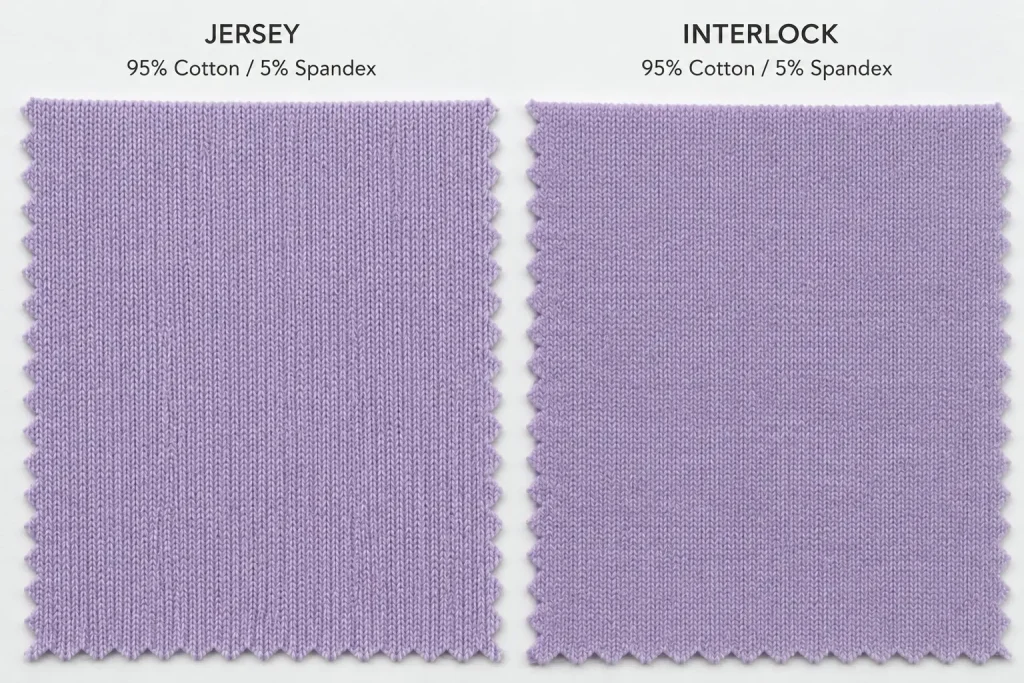
For sourcing teams, the practical implication is straightforward: fiber content labels that list spandex percentage describe the blend ratio, not the performance outcome. A 5% spandex jersey and a 5% spandex interlock will behave differently in both stretch direction and recovery rate, because the construction — not just the fiber — governs how the elastic component is loaded and released.
Side-by-side swatches of jersey and interlock knit at identical spandex content
Knit Structure and Stretch Direction: How Jersey, Rib, Interlock and Scuba Differ
The four knit structures most commonly used in stretch fabric sourcing each have distinct stretch behavior that affects pattern grading, garment fit, and bulk consistency.
Jersey is the lightest and most common base for stretch fabric. In a single jersey construction without spandex, stretch runs primarily across the width of the fabric — this is 2-way stretch. When spandex is engineered into the construction, jersey may be developed for 4-way stretch, but the result still depends on yarn selection, stitch density, finishing tension, and the target recovery requirement.
For structured apparel where silhouette retention matters — blazers, fitted trousers, ponte-style garments — interlock knit fabric delivers more predictable bulk behavior. Interlock is a double-knit structure in which two sets of needles produce a fabric that looks identical on both faces. This double-layer construction limits the amount of stretch but significantly improves dimensional stability. Interlock with spandex delivers moderate 2-way or 4-way stretch that holds shape across production runs.
Rib knit is the go-to stretch fabric structure for high-elasticity applications: waistbands, cuffs, necklines, and fitted casualwear. The alternating knit-purl column structure creates pronounced horizontal stretch — significantly more than jersey at equivalent GSM and spandex content. The elongation-to-recovery ratio in rib tends to be favorable, which is why rib knit fabric is frequently specified for body-conscious styles where the fabric needs to conform to the wearer's silhouette and return to shape repeatedly.
For performance-oriented stretch fabric applications — activewear, bodywear, compression-adjacent garments — scuba knitted fabric offers structured 4-way stretch with firm recovery. Scuba knitted fabric is often developed as a dense double-knit structure using polyester-spandex or other elastane blends. Compared with lighter single knits, it generally offers firmer recovery and better edge stability during cut-and-sew production.
Spandex Ratio in Stretch Fabric: What Changes as the Percentage Rises
Spandex percentage is the specification most buyers request first, and the one most likely to be misunderstood. The fiber content number listed on a swatch card describes the proportion of spandex in the blend — it does not directly translate to a stretch percentage or a recovery rating. Spandex content primarily governs recovery force: how strongly the fabric pulls back after being stretched, and how consistently it maintains that pull-back over repeated cycles.
At lower spandex content levels — typical for everyday casualwear and basic knit tops — the fabric has enough recovery to maintain shape under normal wear, but may show dimensional relaxation after repeated laundering. This range is appropriate for garments where stretch is a comfort feature rather than a structural requirement.
At moderate content levels, the fabric begins to conform more actively to body contours and recovers more consistently after dynamic movement. This is the appropriate range for fitted knitwear, leggings for casual use, and body-conscious tops where fit retention across multiple wears matters.
At higher spandex content — used in compression garments, performance activewear, and technical bodywear — recovery force increases significantly. The fabric exerts measurable pressure on the body when worn, which is the functional requirement for compression products. This range typically requires higher production care, as the fabric tension affects yarn handling, stitching consistency, and finishing procedures.
An important caveat for sourcing teams: increasing spandex content beyond a functional threshold does not continue to improve performance linearly. Beyond a certain point, higher spandex content increases fabric cost and can reduce air permeability without delivering proportional gains in recovery. The appropriate ratio depends on the construction, the base fiber, and the garment's end-use requirements — not on a universal rule of thumb.
The relationship between spandex content and stretch behavior also varies significantly by base fiber. Cotton-spandex blends behave differently from polyester-spandex or nylon-spandex at equivalent ratios, because the base fiber's own stretch characteristics interact with the elastic component. For a detailed breakdown of how cotton compares to cotton-spandex in stretch and recovery, see cotton vs cotton-spandex jersey: stretch, recovery and cost trade-offs.
2-Way vs 4-Way Stretch Fabric: Which Configuration Fits Which Garment
Stretch directionality is a specification that affects both pattern grading and end-use performance, but it is often overlooked in initial sampling requests. The distinction matters at the bulk scale: a garment patterned for 4-way stretch fabric will fit inconsistently if produced in a 2-way stretch fabric, regardless of whether the spandex ratio is identical.
2-way stretch fabric extends across one axis — almost always the width (crosswise grain). This is the natural behavior of most weft-knit constructions without spandex added in both directions. 2-way stretch is sufficient for garments where the primary movement demand is lateral: fitted tops, straight-leg trousers, and garments with minimal vertical tension during wear. It is also the more dimensionally stable configuration, as the fabric resists lengthwise deformation that would otherwise cause garments to grow in body length after washing.
4-way stretch fabric extends across both width and length. This requires either a construction specifically designed for multidirectional elasticity — such as circular-knit jersey or interlock with spandex incorporated at the knitting stage — or a base structure with inherent length-direction flexibility. 4-way stretch is the standard specification for activewear, yoga and pilates wear, swimwear bases, and any garment that must accommodate dynamic movement in multiple body planes simultaneously.
From a bulk production standpoint, 4-way stretch fabric requires more precise tension management during cutting and sewing. Fabric that stretches in two directions is more prone to pattern piece distortion if laid incorrectly before cutting, and seam stability requires stitch types that elongate with the fabric rather than locking in a fixed position.
When yarn count, fiber content, and finishing conditions are comparable, machine gauge can influence loop density, stretch ceiling, and recovery behavior. A finer gauge often produces a more compact surface, while a coarser gauge may allow more visible loop movement. Buyers should treat gauge as one construction variable, not a standalone predictor of stretch performance. For more on how machine specification translates to fabric structure, see the knitting machine gauge and its effect on knit structure.
Bulk Approval Specs for Stretch Fabric: What to Confirm Before Placing an Order
Fabric stretch and recovery failures in bulk are rarely the result of a single variable. They typically arise from the interaction between spandex content, yarn quality, construction tension, and finishing conditions — none of which are fully captured in a fiber blend label. For sourcing teams, the appropriate response is to confirm a specific set of performance specifications at the sampling stage, before bulk production is authorised.
Elongation percentage is the primary stretch specification. It should be measured and reported separately for the lengthwise and widthwise directions. A fabric described as 4-way stretch should demonstrate meaningful elongation in both axes; if the lengthwise value is negligible, the fabric is functionally 2-way regardless of how it is described.
Recovery percentage should be measured after a defined number of stretch-and-release cycles, not just from a single extension. A fabric that recovers fully from one stretch event may still degrade after ten or twenty cycles, which is closer to what the garment will experience during a typical week of wear. The relevant test method is ASTM lD2594 (Standard Test Method for Stretch Properties of Knitted Fabrics Having Low Power), which provides a standardised procedure for measuring residual extension after cycling. Buyers should confirm which test method was used when receiving supplier data, as different methods produce non-comparable results.
Wash dimensional stability is the third critical metric for stretch fabric approval. Washing cycles can cause spandex fibers to relax, particularly if high-temperature conditions are used during finishing. The lengthwise dimension is most vulnerable: fabrics that show acceptable stretch and recovery on the grey goods may still exhibit measurable lengthwise shrinkage after washing, which translates to garments that run short in finished length after the consumer's first wash. Confirm wash stability data from the same fabric batch, not from a different run or finish lot.
A practical framework for pre-bulk approval:
Request: elongation % in both lengthwise and widthwise directions
Request: recovery % after multi-cycle testing (specify number of cycles relevant to your end-use)
Request: Wash dimensional change % after the laundering method specified on your care label
Confirm: the stretch and growth test method used, such as ASTM D2594/D2594M for low-power knitted fabrics, so supplier data can be compared across sampling rounds. Use separate methods for wash, dimensional change or high-power compression requirements where applicable.
Verify:that the tested sample was produced under the same machine settings and spandex lot that will be used in bulk, not a pre-production prototype
It is also worth confirming whether the spandex is incorporated as bare yarn, covered yarn, or core-spun, because yarn form can influence tension control, finishing behavior, and recovery consistency. If high-temperature dyeing or finishing is involved, ask the supplier how recovery is verified after processing. These details are appropriate to raise at the sampling stage, not after bulk approval.
FAQ
What specs should I request when sampling stretch fabric for knit apparel?
Request elongation percentage in both directions (lengthwise and widthwise directions), recovery percentage after multi-cycle testing, and wash dimensional stability data. Confirm the test method used — ASTM D2594 is a common reference for low-power stretch knits. Also confirm whether the tested swatch was produced under the same machine settings and spandex lot that will be used in bulk production.
Does a higher spandex percentage always mean more stretch?
Not directly. Spandex primarily increases recovery force — how strongly the fabric pulls back after stretching. The amount of stretch is largely determined by the knit structure and construction tension. Two fabrics with identical spandex ratios can produce very different elongation percentages if their base constructions differ. Specify both elongation and recovery as separate parameters, not spandex content alone.
Can rib knit fabric be used as a stretch fabric for compression garments?
Rib knit can work for waistbands, cuffs, fitted casualwear, and close-fit apparel that needs strong widthwise recovery. For medical or performance compression products, rib structure alone is not enough. Buyers should confirm pressure requirements, elongation, recovery, and sustained compression data against the relevant market standard before approving bulk production.
Runtang Tex manufactures stretch fabric across rib knit, interlock, and scuba knitted fabric structures for apparel brands in Europe, North America, and Australia. Request a sample or get a quote before bulk approval.

 Technical Know-How