BlogKnitting Machine Gauge: How It Sets Hand Feel, Stitch Density and Production Speed
Knitting Machine Gauge: How It Sets Hand Feel, Stitch Density and Production Speed
May 21, 2026
Table of Contents
A factory quotes 24G or 28G on a spec sheet, and most sourcing teams move on. But that number is not a minor technical detail — it can decide whether the finished fabric matches your hand-feel reference, whether the GSM target is realistic, and whether bulk production stays close to the approved sample. Here is what you need to check before approving.
What Knitting Machine Gauge Actually Measures
Gauge — expressed as needles per inch (NPI) — describes how many needles are set into the cylinder or bed of a knitting machine within one linear inch. A higher gauge number means needles are spaced more closely together; a lower gauge number means wider spacing between needles.
For circular knitting machines used in standard knit fabric production, gauge ranges broadly from single-digit values for heavier structures up to 40-gauge and above for fine-count constructions. CottonWorks notes that standard knits commonly fall in the 20–44 gauge range, with fine-gauge constructions extending further depending on fiber and application.
What gauge does not tell you directly is the final fabric weight or fiber content — those are determined by yarn, construction, stitch length and finishing. What it does set is the needle spacing framework: how closely needles can form loops, what yarn count range the machine can handle, and how fine or open the fabric structure can realistically become. From a sourcing standpoint, gauge is a machine constraint, not a variable your factory can freely adjust run to run.
How It Controls Hand Feel and Fabric Surface
The tactile character of a knit fabric — whether it reads as smooth and refined or textured and open — is strongly influenced by stitch density, and gauge is one of the key machine settings behind that density.
On higher-gauge machines, more needles per inch means more interlocking loops in the same surface area. The result is a tighter construction: finer surface texture, flatter face, and a hand feel that tends toward smooth and controlled. This is the typical output for structured jersey and interlock used in fitted garments and base layers.
On lower-gauge machines, the wider needle spacing creates a more open loop structure. Fabric surface has more visible texture, greater breathability, and a hand feel that reads as softer and more relaxed — depending on yarn. This is common in rib knit constructions and certain fleece structures.
The sourcing implication is direct: if your brief requires a smooth, flat jersey surface, but the quoted machine gauge is more suited to an open, textured construction, the sample may already be structurally misaligned. Yarn choice and finishing can adjust the final hand feel, but they usually cannot fully override a gauge mismatch. Confirming gauge at the sampling stage — and asking whether bulk production will use the same machine specification — is one of the clearest ways to reduce hand-feel variation between sample approval and delivery.
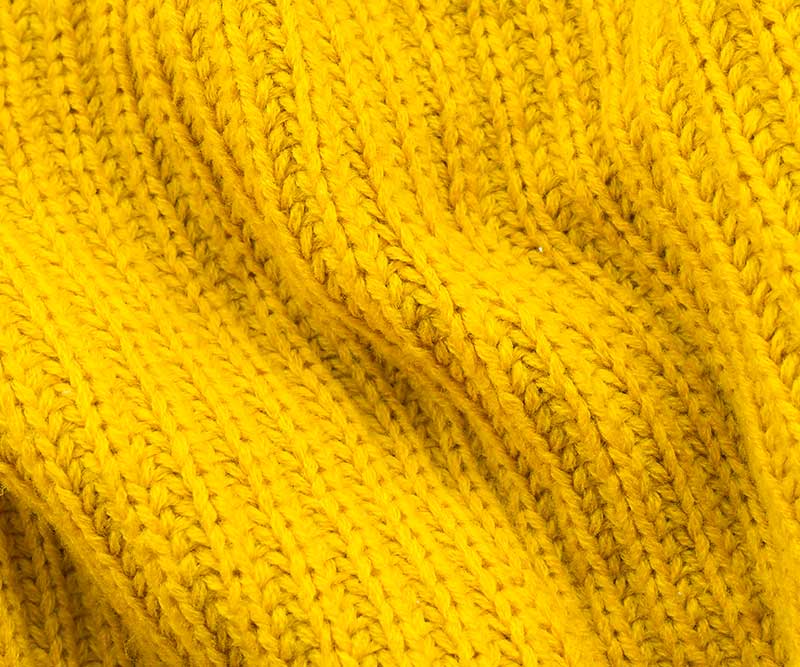
Higher gauge produces a tighter, smoother face; lower gauge yields a more open, textured surface — both are direct outputs of needle density
Gauge, Yarn Count and GSM: Why Buyers Must Check All Three
Gauge and GSM are linked, but they are not a one-to-one conversion. Machine gauge constrains the yarn count range a factory can run, while stitch length, construction and finishing still affect the final fabric weight. For buyers, this means a quoted gauge number should always be checked together with yarn count and target GSM, not reviewed as a standalone technical detail.
Higher-gauge machines are built to handle finer-count yarns. Finer yarns tend to produce lighter fabric weights when all other construction variables are held constant. Lower-gauge machines accommodate heavier, coarser yarns that can yield higher GSM outputs. This is a directional relationship — the specific GSM range achievable on any machine will depend on construction, loop length, and finishing, which vary across factories and production runs.
For buyers, this creates a practical checkpoint: if a development brief specifies a target GSM that sits outside what a given gauge-and-yarn-count combination can realistically produce, the factory either needs to adjust construction variables (which may affect hand feel) or the spec needs to be reconsidered before samples are cut. Raising this question before the first sample is ordered — not after three rounds of rejections — saves significant lead time.
The relevant fields to confirm with your factory contact are: machine gauge, intended yarn count range, and expected GSM at the target construction. If those three inputs are consistent, the sample has a reasonable chance of hitting the weight spec. If they are misaligned, no amount of finishing adjustment will close the gap. For jersey knit fabric developments in particular, GSM targets can vary widely depending on end use — lightweight styles for summer tees operate under completely different gauge-and-yarn logic than heavier jersey used in structured outerwear inners.
Production Speed Depends on Gauge, Feeders and Machine Allocation
Gauge can affect production planning, but it should not be treated as the only driver of speed. Actual output depends on the machine type, cylinder diameter, number of active feeders, yarn behavior, stitch length and the tolerance level required for the order. A fine-gauge jersey development may require tighter monitoring, while a heavier rib or interlock order may be limited by yarn availability or machine allocation rather than gauge alone.
For sourcing teams, the practical question is not simply “which gauge is faster?” Ask whether the bulk order will run on the same gauge as the approved sample, whether the yarn is already available, and whether the machine slot is reserved. These checks make lead-time commitments more reliable than a general production-speed estimate.
Circular vs Flat Knit: What Knitting Machine Gauge Range to Expect
Gauge does not operate in isolation from machine type. The two main machine categories used in knit fabric production — circular knitting machines and flat-bed (flat knit) machines — have different gauge ranges, different production outputs, and different fabric capabilities.
Circular machines are the primary platform for high-volume knit fabric production: jersey, interlock, rib, and their variants. They run continuously and are well-suited to bulk fabric output. Gauge ranges on circular machines span from coarse constructions for heavy-weight knit through to fine-gauge configurations for lightweight, smooth-face fabrics.
Flat-bed machines, by contrast, are often used for shaped garment panels, sweater structures, collars and decorative stitch work. Many of these developments use coarser-gauge setups than fine circular jersey production, but the exact gauge still depends on the machine model, yarn count and stitch design.
For most knit fabric sourcing — including rib knit fabric, interlock knit fabric, and standard jersey — circular machines are the relevant platform, and gauge selection within that platform determines the fabric character. Understanding the difference between machine types prevents misaligned expectations when reviewing factory capability statements. For a deeper look at how circular and flat knit production differ in output and application, see our overview of circular knit vs flat knit production.
FAQ
Does changing the gauge between sampling and bulk production affect the final fabric?
Yes — and it is one of the most common sources of hand-feel discrepancy between an approved sample and bulk delivery. If the bulk order runs on a different gauge machine than the sample, the loop density changes, which can alter surface texture, weight, and drape even when the same yarn is used. Always confirm with your factory that the bulk order will run on the same gauge specification as the approved sample.
What gauge is typically used for jersey, interlock and rib knit fabrics?
Gauge ranges vary across factories and construction targets, so specific numbers should be confirmed at the sampling stage. As a directional reference: finer jersey and interlock constructions for fitted apparel tend to run on higher-gauge circular machines, while rib constructions and heavier jersey may run on lower-gauge configurations depending on yarn count and target GSM. Your factory contact should be able to confirm the machine gauge used for any quoted construction.
Runtang Tex produces jersey, interlock and rib knit fabrics across a range of gauge specifications for apparel brands in Europe, North America and Australia. Request a sample or get a quote to start your sourcing process.


 Technical Know-How