BlogWaffle Knit Fabric Shrinkage: What Apparel Brands Need to Know
Waffle Knit Fabric Shrinkage: What Apparel Brands Need to Know
May 12, 2026
Table of Contents
Waffle knit fabric has a three-dimensional grid texture that gives it warmth, surface depth, and a distinctive hand feel. The same structure also makes shrinkage control more important during sampling. If brands do not define washing method, shrinkage tolerance, and pre-shrinking requirements before bulk production, the first wash may create fit deviations in sleeve length, body length, or garment width.
Why Waffle Knit Shrinks Differently from Standard Knits
The waffle structure is created through a raised grid pattern that forms recessed pockets and surface ridges. Compared with flatter knits, this textured construction may hold and release tension differently during washing and drying. Heat, moisture, yarn type, and finishing method can all affect how much the fabric relaxes after laundering.
The construction also tends to shrink differently in each direction. Shrinkage should be measured separately in the wale and course directions. In waffle knit, directional shrinkage may affect garment proportions — especially sleeve length, body length, and hem width — so both values should be confirmed before pattern grading.
Fiber content is one of the main variables affecting shrinkage behavior. In general, higher cotton content may carry a higher shrinkage risk, while polyester can help improve dimensional stability. Spandex mainly affects stretch recovery and measurement accuracy after laundering. However, final results still depend on construction, finishing, GSM, and washing conditions.
Polyester content generally improves dimensional stability
Cotton / Spandex blend
Target tolerance to be confirmed by wash test
Target tolerance to be confirmed by the wash test
Actual tolerance depends on fiber content, GSM, finish, washing method, and the buyer-approved test standard. All values in the table should be treated as starting targets and confirmed through wash testing on approved samples.
A note on spandex blends: Spandex adds elastic recovery, which can partially mask true shrinkage during a standard flat measurement. Always test spandex-blend waffle after the fabric has fully relaxed — a minimum of 24 hours laid flat after washing — before recording final dimensions.
Runtang's waffle fabric range can be developed from 160 GSM to 420 GSM across different fiber constructions. In many cases, denser constructions may show better dimensional stability than lighter, more open textures, but the final result should still be confirmed through washing and relaxation tests.
Pre-Shrinking at the Mill: Options and Trade-offs
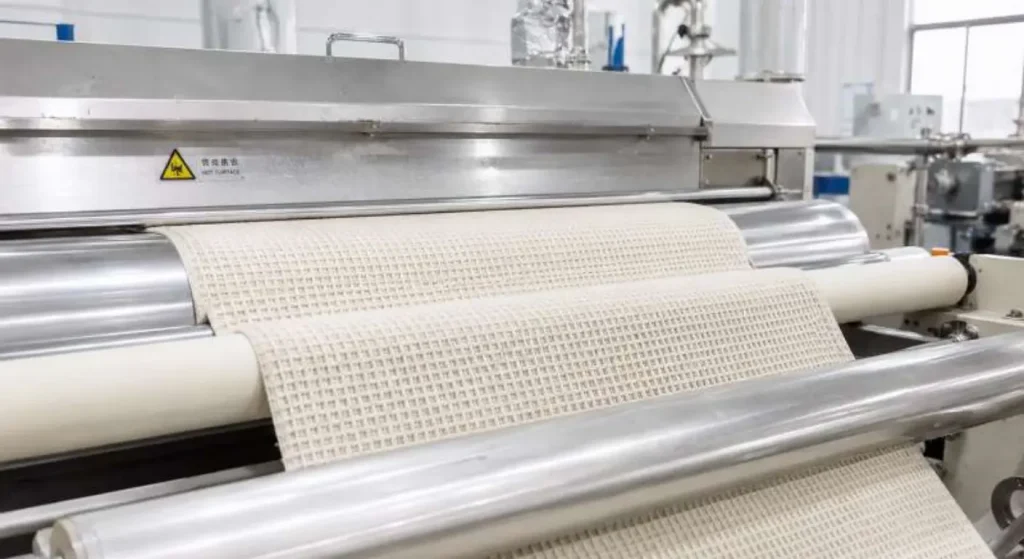
Waffle knit fabric being processed through pre-shrinking treatment at a knit fabric manufacturing facility
Pre-shrinking forces the fabric to undergo controlled dimensional change before it reaches the cutting room, reducing the risk of fit deviation after the first consumer wash. Pre-shrinking options should be confirmed based on fabric construction, order requirements, and finishing route. Common approaches include mechanical pre-shrinking and wet pre-shrinking, each with different effects on residual shrinkage and surface texture.
Mechanical pre-shrinking uses controlled compression and tension to reduce residual dimensional change. For waffle knit, the finishing route should be tested carefully, because excessive pressure may affect the raised grid texture.
Wet pre-shrinking may provide more predictable dimensional results in some high-cotton waffle constructions, but it should be balanced against hand feel, texture depth, and approved sample appearance.
Runtang can arrange pre-shrinking treatment on request. The appropriate method depends on the specific construction, GSM, and dimensional tolerance required. Buyers should raise this requirement at the sampling stage, not after bulk fabric is produced, so the method can be agreed upon alongside sample approval.
Pre-shrinking reduces initial shrinkage but does not eliminate residual shrinkage entirely. A written shrinkage spec in the tech pack remains necessary even when pre-shrinking is applied.
How to Spec Shrinkage in Your Tech Pack
Shrinkage tolerance without a defined test condition is commercially unenforceable. Three parameters need to be agreed upon before production begins:
Wash method and drying condition. Different buyers may specify different washing and drying conditions depending on the retail market, care label, and internal QC policy. The selected method should match the garment's intended care instruction and the buyer's required test protocol.
Test standard. Runtang can arrange dimensional-change testing according to buyer-required methods, such as AATCC TM135 for fabric dimensional change after home laundering, or washing and drying procedures aligned with ISO 6330 where applicable. If your downstream retailer has a required protocol, confirm it before sampling.
Tolerance values for both directions. Specify length and width shrinkage separately. Waffle knit's directional behavior means a single combined tolerance misses the pattern grading implications.
Most noticeable relaxation often appears after the first wash, but additional dimensional change can still occur depending on fiber content, washing temperature, drying method, and finishing route. For strict programs, confirm the required number of wash cycles in the test protocol.
FAQ
What shrinkage tolerance should I specify for waffle knit fabric in my tech pack?
For cotton-dominant waffle knit, some apparel programs may start with separate length and width targets — such as length ≤ 5% and width ≤ 3% — but the final tolerance should be confirmed through sample testing, care-label conditions, and buyer requirements. Discuss the target with your supplier at the sampling stage before applying it to bulk orders.
Does pre-shrinking at the mill eliminate residual shrinkage?
No. Pre-shrinking can reduce initial shrinkage and help bring the fabric closer to the agreed tolerance range, but it does not eliminate residual shrinkage. A written shrinkage spec in the tech pack remains necessary even when pre-shrinking is applied.
Runtang Textile manufactures waffle knit fabric from 160 GSM to 420 GSM, with pre-shrinking available on request. Request a sample or get a quote to confirm shrinkage tolerance, washing method, GSM, and fiber construction before bulk ordering.

 Technical Know-How

