BlogFabric Stability in Knit Apparel: Why Ponte, Scuba and Double Knit Hold Shape
Fabric Stability in Knit Apparel: Why Ponte, Scuba and Double Knit Hold Shape
May 18, 2026
Table of Contents
Fabric stability is not guaranteed by a fabric name. Ponte, scuba, and double knit are the three knit constructions most often specified for structured garments, and each achieves shape retention through a different combination of construction and fiber. Before bulk production, knowing why they hold shape matters as much as knowing that they do.
What Drives Fabric Stability: The Double-Layer Construction Logic
Unlike single jersey, which is made with one set of needles and is more prone to edge curling and directional distortion, double-knit fabrics are formed with two sets of needles. The resulting two-face loop structure gives the fabric more balanced tension in the wale and course directions. This is why ponte, scuba, and many double-knit constructions are usually more stable than single jersey after cutting, washing, and bulk handling.
The standard measure for this property is dimensional change percentage after laundering — a quantifiable indicator of how much a fabric shifts in length or width after a wash cycle. For structured garment categories, a lower dimensional change rate translates directly to silhouette consistency across bulk units and reorders.
Ponte Roma — Dense Structure for Tailored and Workwear Applications
Ponte Roma fabric is a double-knit construction typically produced from blends of rayon, nylon, and spandex, though the exact composition may vary depending on construction and finishing requirements. The interlocked loop structure gives Ponte its characteristic density and bi-directional stretch with controlled elongation, which is why it is commonly specified for tailored dresses, pull-on trousers, and blazer-weight knit garments. For full product specifications, see our Ponte Roma fabric page.
GSM for Ponte constructions can range widely depending on the yarn and finishing applied. For structured tailored applications, medium-to-heavyweight constructions are more common, though exact GSM should be confirmed with the factory at the sampling stage. The key spec to verify before bulk is wash-cycle dimensional change — the percentage shift in length and width after standard laundering determines whether the garment silhouette will remain consistent across production lots.
Scuba Knit — Synthetic Structure for Firm Hand Body
Scuba knit fabric is also a double-knit construction, often made with synthetic-dominant blends such as polyester and spandex, depending on the required hand body, stretch, and thickness. Compared with ponte, scuba is usually selected for a smoother surface and firmer structure rather than a soft drape. Its dense construction can give garments a cleaner outline, but elongation and recovery still need to be confirmed by sample testing. You can explore scuba knit fabric specifications on the product page.
This makes scuba a common choice for fitted dresses, structured skirts, and outer-layer pieces where a clean, pressed silhouette is the brief. It is not the same material as neoprene, though it is often compared visually — for a full breakdown of how these constructions differ, see our article on scuba fabric vs neoprene.
For brands sourcing structured knit for fitted apparel, scuba should be assessed by stretch recovery, hand feel, thickness, and breathability together. Synthetic-dominant constructions can support a cleaner surface and firmer silhouette, but shade approval, lab dips, and bulk color matching still need to be confirmed during sampling.
Double Knit as a Construction Category — What Ponte and Scuba Share
"Double knit" describes a construction method, not a single fabric. Both ponte and scuba fall under the double-knit category, as do a range of interlock-type constructions. This distinction matters for sourcing: two fabrics both labelled "double knit" can behave very differently depending on the gauge of the machine used, the yarn count, and the finishing applied. See the double knit fabric page for construction options across the range.
For buyers, this means fabric stability cannot be confirmed from a name or a swatch alone. When requesting samples, it is worth asking the factory to confirm the gauge, nominal GSM, and composition alongside a wash-test result — not just the fabric's trade name.
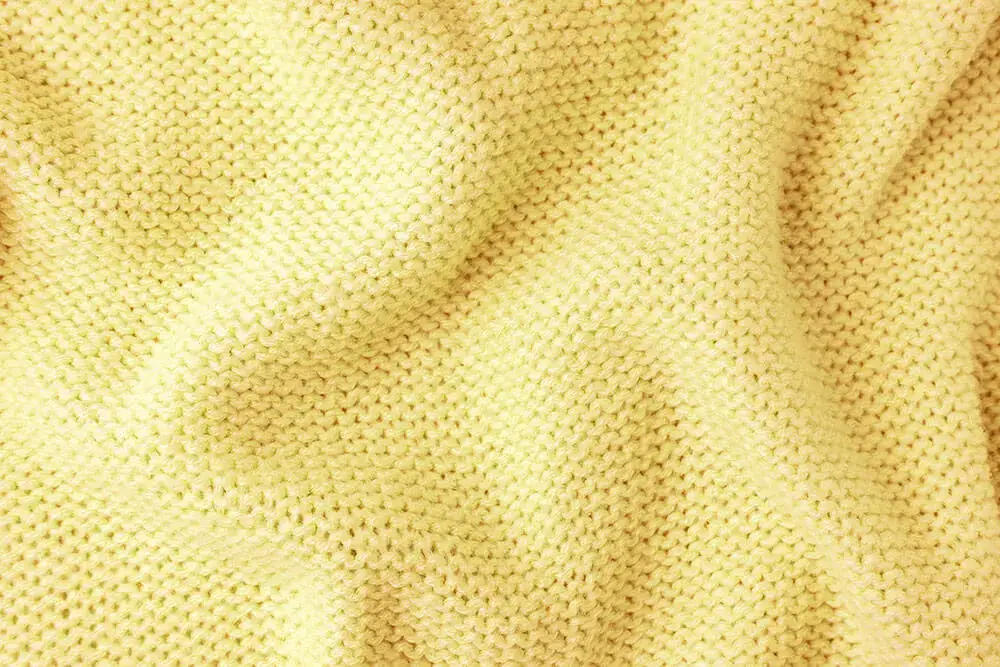
Close-up of double knit fabric showing dense two-face structure
Fabric Stability Specs to Verify Before Sampling
Before approving a structured knit for bulk production, request the following from your factory:
Dimensional change % after wash — tested to AATCC Test Method 135 or equivalent. This measures how much the fabric shifts in length and width after a standard laundering cycle. A lower percentage indicates better dimensional stability and silhouette consistency across bulk units. Reference: AATCC TM135.
Stretch recovery rate — the percentage of original length recovered after stretching to a defined extension. This confirms whether the fabric will return to its original shape after garment wear, not just on the bolt.
GSM tolerance band — the declared GSM and the acceptable production tolerance. GSM variation between sampling and bulk delivery is a common quality gap in structured knit production. Confirm the acceptable range at the sampling stage, as this can vary depending on construction and finishing.
FAQ
What GSM range is common for ponte or scuba in structured garments?
GSM varies significantly depending on the construction and finishing applied. Ponte constructions used for tailored garments may range from medium to heavy weight, while scuba can vary depending on the intended silhouette and application. Confirm the target GSM and acceptable tolerance at the sampling stage — the range should be agreed with the factory rather than assumed from a category label.
How do I verify fabric stability before placing a bulk order?
Request a wash test report referenced to AATCC Test Method 135 alongside the sample. This gives a dimensional change percentage in the length and width directions after laundering. For ponte and scuba, also confirm stretch recovery on the sample, because dimensional stability after washing and recovery after wear are separate approval checks.
Can scuba and ponte be used interchangeably in the same garment design?
Not reliably. Although both are double-knit constructions, they differ in surface texture, drape, and elongation. Ponte typically has more drape and a matte surface texture; scuba has more body and a smoother finish. The same pattern graded for ponte may need adjustment if cut in scuba. Confirm the correct construction against the garment's silhouette requirement during initial sampling.
Verify construction and stability specs on your next structured knit brief. Request a sample from our double knit range, or get a quote for ponte roma in your target GSM and composition.


 Technical Know-How