BlogFabric Spirality and Shrinkage in Knit: Test Methods and Bulk Production Control
Fabric Spirality and Shrinkage in Knit: Test Methods and Bulk Production Control
May 25, 2026
Table of Contents
A batch of single jersey T-shirts cleared sampling — then came back from the cut room with side seams consistently off-center, and post-wash measurements outside tolerance. Both failures trace to the same gap: spirality and shrinkage were not confirmed as a pair at the sample stage. They test differently, affect garment quality differently, and require separate entries on your spec sheet.
Two Different Failure Points, One Shared Spec Sheet Gap
Shrinkage and spirality are often grouped together in conversation, but they describe two distinct dimensional problems in knit fabric.
Shrinkage refers to the reduction in fabric length or width after washing — a measurable change that directly affects pattern sizing and finished garment dimensions. Spirality, also called skew or torque, describes a rotational distortion in which the wales of a knit fabric angle away from vertical. In a finished garment, this shows up as twisted side seams, off-center plackets, or front panels that migrate laterally after the first wash cycle.
The two problems have different root causes, different risk profiles by fabric construction, and require different test methods. Yet many sourcing teams only request shrinkage data at the sample stage, and encounter spirality as a bulk rejection or customer complaint rather than a pre-production checklist item.
For weft-knit fabrics, a widely cited reference range for dimensional change (shrinkage) runs to ±7% for single jersey and related open constructions, with tighter tolerances — often around ±2% — referenced for interlock and rib structures. These figures should be treated as starting benchmarks only; your brand standard or buyer QA manual takes precedence, and tolerances should be defined in the tech pack before sampling begins. For spirality, a deviation of up to 5% is a commonly referenced starting point for single jersey constructions, but this varies by brand specification and end use. Any tolerance you intend to enforce must be agreed in writing before bulk fabric is approved.
Which Knit Structures Carry Higher Fabric Spirality and Shrinkage Risk
Construction type is the single most reliable predictor of which dimensional problem is more likely to appear — and how severe it may be.
Single jersey fabric, produced on circular weft-knitting machines, is the construction most prone to spirality. The loop geometry of a single-layer weft-knit fabric creates inherent torsional stress during production. When that stress is released during finishing or consumer washing, the fabric tends to rotate, pulling wales away from a perpendicular alignment with the courses. This is a well-documented characteristic of the construction rather than a random defect — but it must be measured and controlled before bulk approval, not assumed to be within tolerance.
Interlock and rib knit fabric constructions are generally more dimensionally stable in the wale direction. Their interlocked or doubled loop geometry distributes tension more evenly, significantly reducing the rotational pull that drives spirality. Shrinkage remains a relevant test variable for both — particularly for cotton and cellulosic blends — but the spirality risk profile is lower than for single jersey.
This structural difference matters for how testing resources are allocated across a multi-fabric development season. Running the full spirality protocol, including the washed-bag test method, is most critical for single jersey orders. For interlock and rib constructions, the testing priority can shift toward shrinkage rate, width stability, and recovery — though spirality should not be excluded entirely if the brand has a documented rejection threshold.
Side-by-Side Comparison of the Loop Structure Cross-Sections of Single Jersey and Double Rib Knit Fabrics
Lab Reports to Request Before Bulk Approval
Understanding which test to request — and how to read the output — is where sourcing teams close the most common spec gaps before a bulk run begins.
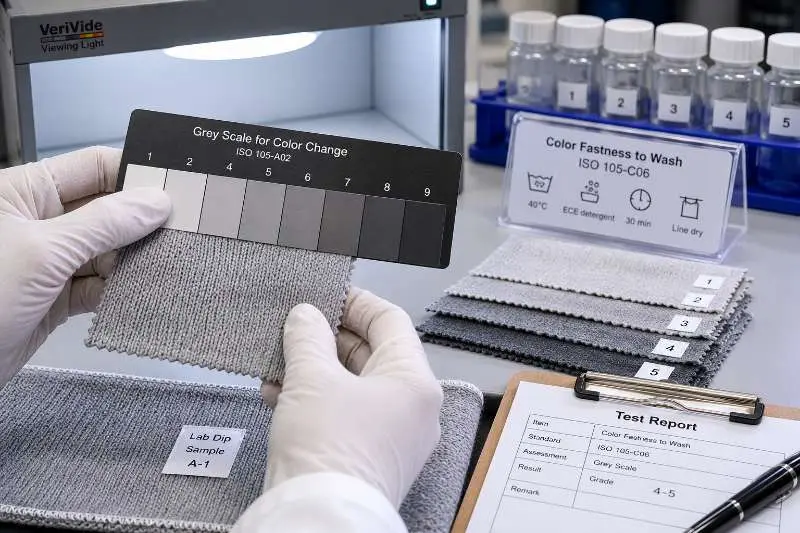
For shrinkage, the two most widely referenced standards are AATCC 135 (Dimensional Changes of Fabrics after Home Laundering) and ISO 6330. Both define washing temperature, drying method, and cycle count. When requesting a test report, verify that the washing conditions match your intended care label. A report run at 30°C for three cycles may not reflect performance for a garment that will be consumer-washed at 40°C or 60°C repeatedly. The number of cycles tested should also align with the expected lifespan of the product — this matters more for children's wear, workwear, or performance apparel than for a single-season fashion item.
For spirality, the main referenced standard is AATCC TM179-2025, Skew Change in Fabrics After Home Laundering. It measures skew change in woven and knitted fabrics after home laundering, so sourcing teams should confirm whether the report follows the standard cycle conditions or an additional brand-specific wash protocol.
When reviewing any dimensional test report, ask for the specific washing temperature, drying method, and cycle count used, not just the percentage outcome. If your buyer requires extended laundering beyond the standard method, list that as a brand-specific approval condition rather than assuming it is part of the default AATCC TM179 report. Bulk approval based on unclear or mismatched test conditions is a common source of post-delivery quality disputes.
Alongside confirming knit fabric GSM selection before sampling, locking dimensional stability data — covering both shrinkage and spirality — into the pre-production sign-off process is one of the most reliable ways to prevent downstream bulk failures.
How Production Controls Both Variables
Production-stage finishing determines whether dimensional test results at the sample stage can be consistently replicated through bulk delivery. Understanding the general approaches used helps sourcing teams ask the right capability questions when reviewing a mill's process.
For shrinkage, compaction finishing is one approach used with certain weft-knit constructions. The process mechanically relaxes the fabric under controlled conditions before delivery, pre-releasing dimensional energy that would otherwise emerge after the first wash. The degree of shrinkage reduction this achieves can vary depending on fabric construction, fiber content, and the specific finishing parameters applied — some residual shrinkage after repeated wash cycles is typical even in compacted fabric, and results should not be assumed without test data.
For spirality, open-width processing and controlled tension management during dyeing and finishing may help reduce rotational stress in the fabric. Yarn twist balance can also be a contributing variable in single jersey constructions — though the extent to which any of these factors can be controlled depends on the specific construction and the mill's process capability. Not all constructions respond the same way to the same finishing approach, and no single process step eliminates spirality risk entirely for all single jersey fabrics.
The sourcing implication is practical: for orders where spirality tolerance is a defined quality criterion, confirm with the mill what finishing steps are included in the production spec, and request pre-production wash test data before approving bulk. A fabric that passes a post-finishing on-loom dimensional check but has not been washed to the agreed cycle count may not hold within your specified tolerance after delivery.
For both variables, the most reliable protection is consistency between the sample test conditions and the bulk approval conditions — same test method, same cycle count, same washing temperature. Mismatches between sample and bulk test protocols account for a significant share of dimensional rejection disputes.
FAQ
What shrinkage tolerance should I specify for knit fabric in a bulk order?
There is no universal standard — tolerance depends on construction, fiber content, and end use. Many buyers reference ±5% for single jersey as a starting point, with tighter limits for interlock or rib knit fabric. The most reliable approach is to define your tolerance in the tech pack before sampling, run wash tests under the same conditions specified for bulk approval, and confirm that the mill's production test report uses matching parameters. Tolerances specified after sampling is complete are difficult to enforce retroactively.
Is spirality a concern for interlock and rib knit structures, or mainly single jersey?
Spirality is most strongly associated with single jersey, where the single-layer loop geometry creates torsional stress that can cause post-wash rotation. Interlock and rib knit fabric constructions are generally more stable in this regard due to their doubled or interlocked loop structure. However, any weft-knit construction can show some degree of skewness under certain fiber and finishing conditions. If spirality is a defined rejection criterion in your QA standard, confirm testing requirements and tolerance for all constructions included in the order, not only single jersey.
Runtang Tex produces knit fabric for apparel brands across Europe, North America, and Australia. Share your dimensional stability requirements and request samples for pre-bulk testing — including shrinkage and spirality data at your specified wash conditions. Explore our knit fabric range or get in touch to start your sourcing process.


 Technical Know-How