BlogKnit Fabric GSM Guide: How to Set Weight Before Sampling
Knit Fabric GSM Guide: How to Set Weight Before Sampling
May 25, 2026
Table of Contents
GSM appears on every fabric spec sheet, but knowing which number to specify — and making sure bulk production holds to it — is where sourcing decisions succeed or fail. The same weight reads differently across knit constructions. This fabric GSM guide breaks down how to use weight as a sourcing tool, not just a label.
Why Knit Construction Changes How GSM Performs
When sourcing teams compare GSM across knit fabric types, the number alone does not tell the full story. A 200 GSM single jersey and a 200 GSM interlock share the same weight measurement, but they behave like different materials in production and on the body.
Single jersey is a single-needle weft knit — it drapes with more movement and tends to have a thinner cross-section at any given weight. Interlock uses two sets of needles to lock two jersey-structure layers face-to-face. The result at the same GSM is denser, more stable, and more opaque. These structural differences directly affect how fabric behaves through cutting, sewing, and end-wear performance — which is why GSM alone is insufficient as a selection criterion without specifying the construction alongside it.
Fleece and French terry add a different variable: a raised or looped backing that contributes to gram weight through pile volume rather than through knit density. A 300 GSM brushed fleece feels substantial in the hand, but its behavior under mechanical stress — including recovery, dimensional stability, and shrinkage — differs significantly from a 300 GSM interlock at the same reading. The weight number tells you how much fabric you have per square meter; it does not tell you how that mass is distributed or what it does under load.
Yarn count interacts with GSM in ways that matter for sampling decisions. Finer yarns allow more loops per unit area, producing a smoother, denser surface at a given weight. Coarser yarns create a more open structure and loft — the fabric may read heavier in hand feel while staying within the same GSM band. When initiating a sample request, specifying yarn count or yarn specification alongside the target weight helps narrow the brief considerably. For a deeper look at how yarn count affects knit fabric hand feel and performance, see the guide to yarn count in knit fabric.
Setting GSM by End-Use — Your Fabric GSM Guide by Garment Category
The appropriate weight for a knit fabric order depends on where the garment sits in the product range, what fiber content is specified, and how the finished product will be used. The following reference points are organized by garment category and should be read as directional — actual GSM targets depend on construction and finishing, and must be confirmed at the sampling stage.
Base Layer and Performance Activewear
Base layers and close-contact performance fabrics are typically sourced in a lighter GSM band — sufficient to provide coverage and shape retention without adding thermal mass. The exact range depends on construction type and fiber content. A cotton-dominant interlock knit fabric base layer will sit at a higher perceived weight than a polyester-spandex single jersey targeting the same end-use, because fiber density and knit structure both affect how GSM translates into feel and body. In this product category, opacity and stretch recovery are often more critical sourcing parameters than the GSM value alone — both should be specified alongside weight in the sample brief.
Midweight Basics and T-Shirts
Standard jersey knit fabric T-shirts and retail-quality basics span a wide GSM band depending on price positioning and opacity requirements. Lighter constructions serve promotional products and fast-fashion basics; heavier constructions serve premium retail or longer-wear programs where gram weight contributes to perceived quality. Brands requiring greater dimensional stability and opacity at similar weights often move from single jersey into interlock — the double-knit construction provides better edge stability and surface character through repeated laundering without requiring a significant GSM increase.
Hoodies and Sweatshirts
French terry and fleece knit fabric constructions account for the majority of hoodie and sweatshirt sourcing, and both cover a broad GSM range in practice. Weight choice in this category involves more than thermal performance: heavier GSM in a brushed fleece contributes to drape weight and silhouette structure, and perceived quality in premium streetwear programs is closely tied to hand weight. French terry at lower weights retains its loop structure on the reverse but reads lighter in the hand; at higher weights it moves toward outerwear territory. Sourcing teams specifying hoodie fabric weight should confirm the target GSM relative to the specific construction — French terry and polar fleece at the same nominal number behave differently across cutting, sewing, and finished-garment drape.
Heavier Structures and Outerwear Layers
Double-knit constructions — including ponte, scuba, and structured interlock variants — tend to sit in heavier GSM bands where stability and recovery are the primary drivers. These fabrics serve tailored dresses, structured outerwear layers, and performance applications where shape retention under stress matters more than lightweight feel. At higher GSM levels, fiber content and finishing treatments have a significant bearing on how fabric performs through wear and laundering cycles. Dimensional stability should be tested alongside gram weight as a dual verification criterion before bulk approval.
Runtang Tex manufactures knit fabrics across a broad range of constructions and GSM specifications. Reference details for available fabric types are accessible through our full knit fabric range.
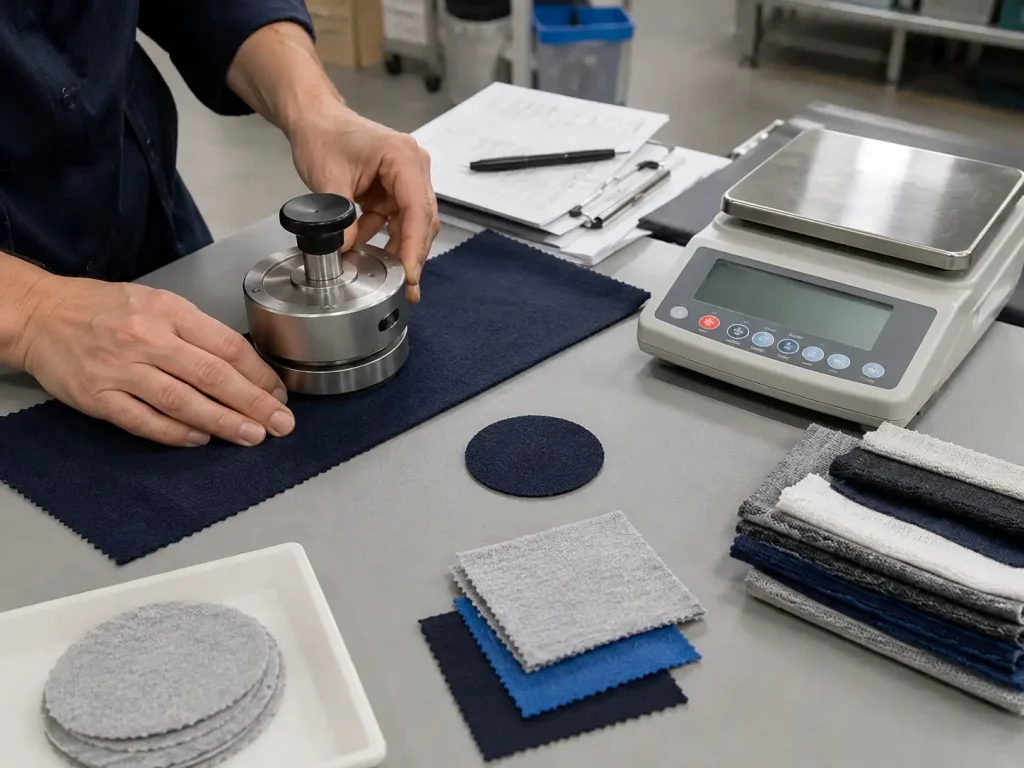
GSM testing on production fabric samples confirms weight specification before bulk orders are approved
Specifying GSM Tolerance — What to Lock In Before Bulk
Once a target GSM is established through sampling, the next step is defining what variance is acceptable in bulk production. This is a point that spec sheets frequently leave unaddressed — and the absence of a stated tolerance is a common source of dispute when production rolls arrive outside the expected weight band.
GSM variance in knit production can arise from multiple sources: tension variation during the knitting process, dye lot differences that alter fiber behavior, or finishing treatments that change fabric weight. A stated tolerance in the spec — expressed as a percentage range around the target — provides a shared benchmark for both brand and factory at the acceptance stage.
The appropriate tolerance band depends on end-use and the GSM level. At lower GSM values, a small absolute variation represents a proportionally larger shift in weight character; at higher GSM values, the same variance may be minor in percentage terms but can still affect drape, opacity, and hand feel depending on construction. Brands with strict opacity requirements or tight cost-per-gram benchmarks generally specify narrower tolerances. Programs sourcing heavier outerwear or structured fabric may find a broader variance acceptable, provided construction character and hand feel remain consistent with the approved sample.
To verify that bulk fabric meets the approved sample specification, sourcing teams should:
Request a GSM test report for each production roll — measured per applicable fabric weight testing standards, such as ASTM D3776/D3776M, Standard Test Methods for Mass Per Unit Area (Weight) of Fabric — and confirm the measurement method is consistent between sampling and bulk stages
Ask for a production lot cutting or header sample before shipment authorization, rather than relying solely on sample-stage documentation
Compare the bulk cutting against the approved swatch under consistent conditions — checking weight, hand feel, and surface character together, not GSM in isolation
When initiating a sourcing brief with Runtang Tex, specifying both a target GSM and an acceptable tolerance range allows us to confirm during the sampling stage whether the construction can hold consistently to that spec at bulk production scale.
FAQ
How should I set GSM for an interlock knit T-shirt before sampling?
Interlock reads differently from single jersey at the same GSM value — the double-knit construction adds density and opacity, so the same weight in interlock feels more substantial than single jersey at an equivalent number. Midweight interlock used in premium basics generally targets a heavier band than a comparable jersey program aiming for the same hand feel. The most productive approach is to include opacity requirements, intended end-use, and target price point in the sampling brief alongside the GSM range — these parameters help narrow the spec before a sample is cut and tested.
How do I confirm that the bulk fabric GSM matches my approved sample?
Request a GSM test report per production roll and ask for a physical cutting from the production lot before authorizing shipment. Compare the bulk cutting against your approved swatch under consistent lighting and handling conditions, checking weight, hand feel, and surface character together. A stated tolerance range in your spec sheet — rather than a single GSM target number — gives the factory a clear acceptance benchmark and reduces dispute at the fabric inspection stage. If the sampling documentation does not include a stated tolerance, request one before proceeding to bulk.
Runtang Tex manufactures knit fabrics across a broad GSM range for apparel brands in Europe, North America, and Australia. Share your end-use requirements and GSM target to request a sample or get a quote.

 Technical Know-How