BlogColor Fastness Testing for Knit Fabric: What Brand Buyers Check Before Bulk Approval
Color Fastness Testing for Knit Fabric: What Brand Buyers Check Before Bulk Approval
May 26, 2026
Table of Contents
Key Sourcing Takeaways
A grey scale grade of 4 is a common baseline for washing and dry rubbing fastness in many buyer specifications, while final thresholds depend on fabric type and end use.
Tie-dye and mineral wash knits carry elevated crocking risk — wet rubbing grades must be verified separately at lab dip and pre-shipment stages.
A fabric that passes the color fastness test at lab dip can still fail in bulk if dye lot consistency, wash process, or pH control drifts during production.
Perspiration and light fastness requirements vary by end use — workwear and outdoor-oriented knits require higher minimums than standard casualwear.
A color fastness test report from your fabric supplier tells you whether the dye holds under controlled lab conditions. What it doesn't tell you is whether those conditions will hold across a 2,000 kg production run. For brand buying teams, the difference between a passed lab result and a failed bulk shipment often comes down to knowing which tests to specify, at what grade threshold, and at which production stage.
What a Color Fastness Test Result Actually Means
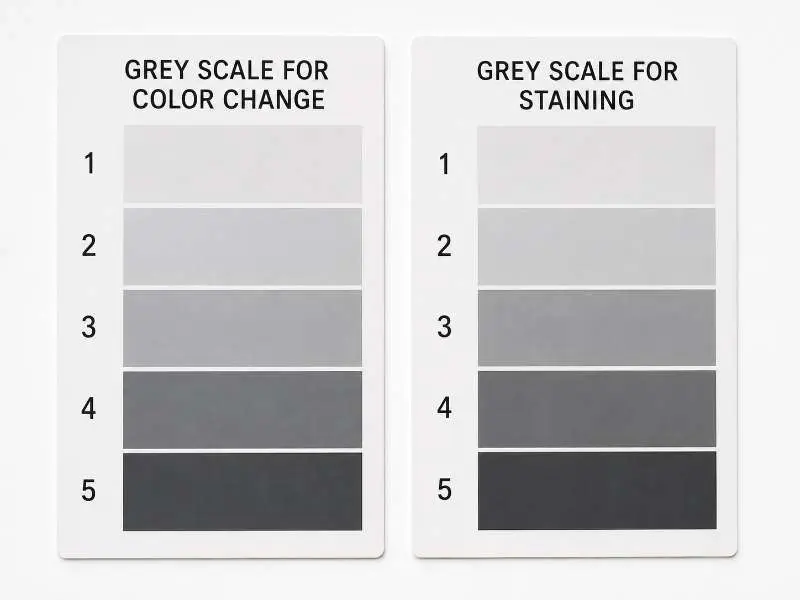
Color fastness is graded on a 1–5 scale using a standardised grey scale. Grade 5 means no detectable change; grade 1 means severe fading or staining. Many export-market buyer specifications use grade 4 as a common baseline for washing fastness and dry rubbing, while wet rubbing may be accepted at grade 3–4 depending on fabric type, dye system, and end use. Results below grade 3 usually require further review and may trigger rejection under stricter buyer specifications.
Two readings matter on every test report: color change (how much the tested fabric faded) and staining (how much dye transferred to the adjacent white test cloth). Buyers who only check the color change figure and ignore the staining score can approve a fabric that bleeds onto linings, care labels, or adjacent garment panels during wear or washing. Both columns should be reviewed before bulk approval is signed off.
The Color Fastness Tests That Matter Most in Knit Fabric Sourcing
Not every test in a full color fastness test panel is equally relevant to every end use. For knit fabric procurement, these four are the ones to specify by default:
Washing fastness (ISO 105-C06 / AATCC 61). The baseline test for any dyed knit fabric. Simulates repeated home or commercial laundering. Grade 4 is commonly used as a baseline in many buyer specifications, but the final requirement should follow the buyer’s quality manual and end-use risk. European and North American buyer specifications may reference ISO 105-C06, while AATCC 61 is common for US-market programs.
Rubbing/crocking fastness (ISO 105-X12 / AATCC 8). Tests how much dye transfers when the fabric surface is physically rubbed. Dry rubbing should commonly reach grade 4, while wet rubbing is often specified at grade 3–4 depending on buyer requirements. On open-loop knit structures, wet rubbing can show a larger performance gap than dry rubbing, so tie-dye fabric and mineral wash fabric should be verified separately at the lab dip and pre-shipment stages. Pigment-type or special-effect dye systems may show lower wet rubbing performance than standard solid piece-dyed fabrics, so expectations should be agreed upon before bulk approval.
Perspiration fastness (ISO 105-E04 / AATCC 15). Simulates the effect of acidic and alkaline sweat on fabric color. Commonly required for activewear and workwear knits, and worth confirming for casualwear where direct skin contact or dark shades are involved. Both acid and alkaline conditions should be tested, as reactive dyes on cotton behave differently under the two.
Light fastness (ISO 105-B02 / AATCC 16). Critical for any knit fabric used in outdoor, uniform, or display-facing applications. Light fastness grades are reported differently — on a 1–8 blue wool scale rather than the 1–5 grey scale — and a grade 4 on the blue wool scale is roughly equivalent to moderate resistance. Some indoor casualwear programs may accept grade 4, while workwear and outdoor categories often require grade 5 or above, depending on exposure risk.
Gray Scale for Assessing Color Change and Staining (Grades 1 to 5)
Why Knit Constructions Create Specific Color Fastness Risks
Knit fabrics are structurally different from woven fabrics in ways that affect color fastness performance — particularly on rubbing tests. The open, looped construction of most knit structures means there is more exposed surface area per unit area compared to a tightly interlaced woven. Under wet rubbing conditions, this can accelerate dye transfer even when the fabric has been properly finished.
Dye class is a key variable. Cotton-based knits are typically dyed with reactive dyes, which form a chemical bond with the fiber. Polyester knits use disperse dyes, which are absorbed into the fiber rather than bonded. Blended knit constructions — common in activewear and performance categories — may require different dye systems for each fiber component. When sourcing blended knits, it is worth confirming which test standard applies to each fiber component, since the dominant fiber may pass while the secondary component shows staining.
For special-effect constructions — including tie-dye fabric and mineral wash fabric — pigment-based or specialty dye systems may be used depending on construction. These can offer strong visual effects but may perform at a lower grade on wet rubbing than conventionally dyed piece-dyed fabric. Buyers sourcing these fabrics should set wet crocking expectations at the sampling stage and not default to the same grade thresholds applied to standard solid knits.
A note on GSM: heavier knit constructions tend to have more dye volume per unit area, which can affect crocking performance under wet conditions. This is a directional risk to be aware of rather than an absolute rule — actual performance depends on dye class, fixation method, and finishing treatment.
The Color Fastness Test Report: What to Request and When
Color fastness is typically first evaluated at the lab dip approval stage. Lab dip reports confirm that the target color, when applied to the correct substrate and construction, meets the required fastness grades under controlled conditions. This is a necessary checkpoint — but not a sufficient one.
Several factors can cause color fastness results to diverge between lab and bulk production:
Dye lot variation. Batch-to-batch variation in dye concentration can affect fixation rates, which in turn affects washing and perspiration fastness. Color consistency within a bulk order should be verified alongside the fastness report.
pH and wash process drift. Post-dyeing wash processes — designed to remove unfixed dye — are critical to washing fastness performance. If pH control or wash temperature varies across production batches, residual dye levels can differ, producing inconsistent test results on goods from the same order.
Finishing changes. Softeners, coatings, and other finishing treatments applied after dyeing can affect rubbing fastness and perspiration fastness. If the finishing specification is changed between lab dip and bulk production — even with the intent to improve hand feel — the fastness profile may shift.
For orders where color performance is a quality priority, a pre-shipment color fastness test from a third-party accredited laboratory — such as SGS, Bureau Veritas, or Intertek — provides independent verification that the bulk production run matches the lab dip approval. This is particularly important for workwear, uniform, and export market orders where color performance standards are specified in buyer contracts.
The ISO 105 color fastness series sits under the ISO textiles testing framework, with ISO/TC 38/SC 1, Tests for coloured textiles and colorants covering testing methods for textile coloration and color fastness. For buyer specifications, reference the exact ISO 105 method required for washing, rubbing, perspiration, or light fastness rather than citing “color fastness” as one general test.
Workwear and Uniform Sourcing: When to Specify Tighter Color Fastness Standards
Workwear and uniform programs create demanding conditions for color fastness. Garments are laundered frequently — often industrially — and subject to perspiration, UV exposure, and physical abrasion at a rate that far exceeds typical casualwear use cycles. For brands and procurement teams sourcing workwear and uniform knit fabric, color fastness requirements should reflect this intensity.
For many workwear and uniform programs, a practical starting point is washing fastness at grade 4–5, perspiration fastness at grade 4 for both acid and alkaline conditions, and light fastness at grade 5 or above on the blue wool scale for outdoor or high-UV exposure. Final thresholds should still follow the buyer’s own quality manual and end-use risk level.
For uniform programs where color consistency across large order quantities is critical, specifying both the fastness grade and the acceptable shade tolerance — typically expressed as a CMC or CIE ΔE value — provides a more complete brief to the fabric team than fastness alone.
FAQ
What color fastness grade should I require for bulk knit fabric orders?
Grade 4 or above for washing fastness and dry rubbing is a common baseline in many export-market buyer specifications. Wet rubbing is typically specified at grade 3–4 depending on fabric category. Workwear and outdoor categories should specify higher — grade 4–5 for washing and grade 5 light fastness. Confirm grade requirements at the lab dip stage so expectations are aligned before bulk production begins.
Does tie-dye or mineral wash fabric require different color fastness specifications?
Yes. Both tie-dye and mineral wash constructions involve dye or effect processes that can produce lower wet crocking performance compared to conventionally dyed solid knits. Wet rubbing grade expectations should be discussed and agreed at sampling — not applied retroactively at pre-shipment inspection. Buyers should confirm acceptable grade ranges for these categories specifically, rather than defaulting to the same threshold used for standard knit fabric.
Can a fabric pass the lab dip color fastness test but fail in bulk production?
It can. Lab dip testing is performed under controlled conditions on a small sample representing the target construction. Bulk production introduces variables — dye lot consistency, wash process stability, finishing treatment uniformity — that are not replicated in a single lab sample. Pre-shipment testing by a third-party laboratory is the most reliable way to verify that bulk production meets the same standard as the approved lab dip.
Start Your Sourcing Process
Runtang Tex produces knitted fabrics for apparel brands across Europe, North America, and Australia. Request a sample or get a quote to begin your fabric sourcing process.

 Technical Know-How

