BlogWhy Your Bulk Color Drifts After Fabric Lab Dip Approval
Why Your Bulk Color Drifts After Fabric Lab Dip Approval
May 26, 2026
Table of Contents
Quick Answer
Fabric lab dip approval does not guarantee bulk color consistency. For knit fabric, three factors most commonly cause post-approval drift:
Greige lot variation — the base fabric's dye absorbency shifts between production batches.
Bulk vat scale differences — dye behaviour at the lab scale cannot fully replicate what happens in a 300 kg jet dyeing machine.
Formula records not retained — without a written dye formula tied to a sealed reference swatch, reorder colour is reconstructed from memory.
Prevention requires written tolerances (Delta E), a sealed reference swatch for every bulk run, and explicit checks for special-effect finishes such as mineral wash or tie-dye.
You approved the lab dip. The colour looked right in the lightbox. Then the bulk rolls arrived and something was off — slightly greener, slightly flatter, or just not quite the shade that went into your tech pack. This isn't uncommon in knit fabric production, and it rarely means the factory made a straightforward error. It means the approval process missed a variable. Here is where those variables hide, and what you can do about each one.
What Fabric Lab Dip Approval Actually Covers
A fabric lab dip is a small dyed swatch submitted by the mill before bulk dyeing begins. Its purpose is to confirm that the target colour — communicated via a Pantone reference, a physical fabric sample, or a digital colour specification — can be accurately reproduced on the specified fabric at the specified construction. Once a brand signs off, that swatch becomes the colour contract for the entire order. Every bulk roll produced from that dye recipe is measured against it.
Lab dip and strike-off serve different functions and are often confused. A lab dip applies to solid-dyed fabrics: the mill dyes a small sample and submits it for shade approval. A strike-off is a printed or yarn-dyed swatch used to verify colour placement, repeat accuracy, and tone interaction in patterned or multi-colour constructions. If your order involves tie-dye or allover print effects, the approval tool changes — but the underlying principle is the same: lock the colour standard before dyeing at bulk scale.
The standard fabric lab dip workflow moves through five stages:
Brand submits colour standard — Pantone chip, physical fabric reference, or digital specification with illuminant requirements.
Mill prepares lab dip swatches — typically two to three formula variations, each dyed on the same fabric construction specified for bulk.
Brand reviews under standardised lighting — D65 (daylight simulation) and TL84 (retail fluorescent) are the industry standard illuminants for knit apparel.
Spectrophotometer measurement — the mill measures colour accuracy numerically and provides Delta E data alongside the physical swatch.
Written approval issued — the brand confirms the accepted submission, retains a sealed reference swatch, and bulk dyeing proceeds.
Where this process often fails is not in the approval steps themselves, but in whether the swatch was prepared on the same knit construction, fibre content, GSM, and finishing route planned for bulk. Knit fabric introduces variables that a basic colour approval workflow can miss if those details are not locked before dyeing.
Why Knit Fabric Lab Dips are More Variable than Woven
In woven construction, yarns interlace under consistent tension. Dye penetration is relatively predictable because the yarn surface exposure is uniform across the fabric width and length. Knit construction works differently: looped structures — particularly single jersey — have open, flexible surfaces that absorb dye at rates influenced by loop tension, stitch density, and, critically, the fibre content of each individual yarn. For brands comparing knit fabric options such as jersey, interlock, rib, or double knit, the lab dip should be prepared on the same construction planned for bulk.
This means the same Pantone reference applied to 100% cotton single jersey and to 95% cotton/5% spandex interlock will produce visually different results, even with the same starting dye recipe. Spandex resists most reactive and direct dyes. At 5%, it may appear negligible, but in shade-sensitive colourways — navy, black, olive, and burgundy in particular — that undyed spandex component creates a visible shift in undertone across the fabric face.
Fibre blends involving modal, bamboo-viscose, or recycled polyester compound this further. Each cellulosic or synthetic component carries a distinct dye affinity and requires a different dye class to achieve full exhaustion. A blend-specific dye formula is not interchangeable with a single-fibre formula, even if the Pantone target is identical.
How Fibre Content Can Change Lab Dip Risk
Fibre/Construction
Colour Approval Risk
Buyer Check Before Bulk
100% Cotton Jersey
Usually easier to match when bulk uses the same greige lot and GSM
Confirm the lab dip was made on the same construction planned for bulk
Cotton/Spandex
Spandex content can affect undertone and visual depth in shade-sensitive colours
Request a construction-matched lab dip, especially for navy, black, olive, and burgundy
Cotton/Modal Blend
Cellulosic blends may show different dye uptake from 100% cotton
Do not approve a cotton-only lab dip for a cotton/modal bulk order
Recycled Polyester Jersey
Disperse dyeing and recycled fibre variation may affect shade repeatability
Confirm fibre source, lot consistency, and colour tolerance before bulk
Bamboo-Viscose Blend
Higher absorbency may shift colour depth depending on blend ratio and process
Approve on the exact blend and GSM planned for production
The practical implication: if your order uses a different fabric construction from the one on which the lab dip was prepared — even if the same fibre content at a different GSM — you need a new lab dip. Approving a lab dip developed on 180 GSM jersey to cover a 220 GSM interlock production run in the same colourway is one of the most consistent sources of bulk colour complaints.
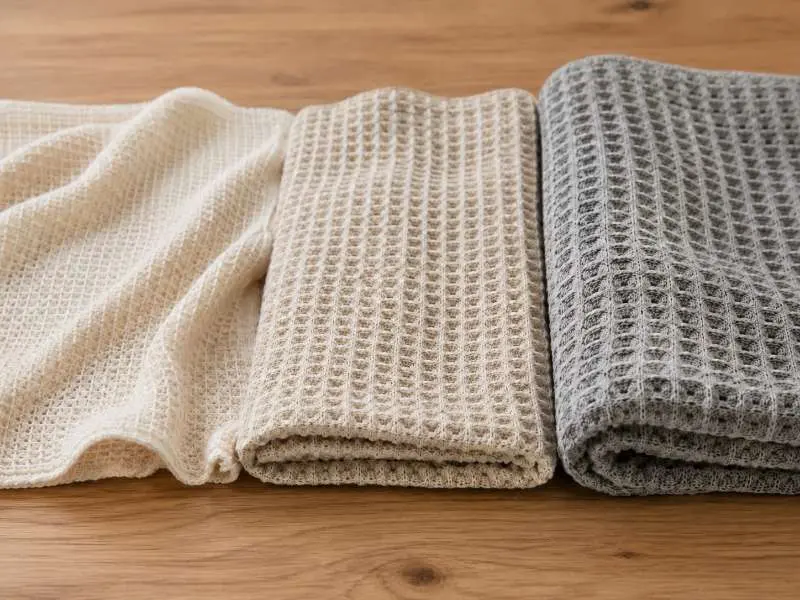
Sample swatches of single-knit and double-knit fabrics—both in a navy blue colourway—clearly demonstrate the color variations resulting from differences in their knitted structures
Setting Colour Tolerances Before You Approve
Approving a lab dip without a defined colour tolerance is not a proper approval — it is a handshake. Tolerance specifies how much the bulk production can deviate from the approved lab dip before the deviation constitutes a rejection. Without a written tolerance on file, disputes over shade variation in bulk have no objective baseline.
Delta E (ΔE) is commonly used as a numerical colour-difference reference when comparing an approved lab dip with bulk fabric. It should not replace visual assessment under agreed lighting conditions. For visual colour evaluation, brands can reference AATCC EP9, Visual Assessment of Color Difference of Textiles, as an external procedure reference. The following ranges can be used as starting points only; final tolerances should be confirmed in the brand’s own approval standard.
ΔE ≤ 1.0 — Near-perfect match. Visible difference requires a trained eye under direct comparison.
ΔE 1.0 – 2.0 — Generally acceptable for most solid-colour apparel applications.
ΔE > 2.0 — Typically flagged for review. Shade-sensitive colours (nude, grey, cream) warrant tighter thresholds than saturated shades.
Lighting conditions affect how the same swatch reads. Metamerism is the phenomenon where two fabrics appear to match under one light source but diverge under another. A lab dip approved under D65 may look noticeably different under TL84 — the fluorescent standard used in most European retail environments. Specifying both illuminants in your approval brief and asking the mill to confirm the swatch holds under both is the step that prevents retail-floor complaints.
What a complete lab dip approval record should contain:
Pantone or colour standard reference number and version year
Fabric construction and fibre content the lab dip was prepared on
GSM of the lab dip sample fabric
Illuminants used during review (minimum: D65 and TL84)
Accepted Delta E tolerance (numeric, not 'close enough')
Sealed physical reference swatch (minimum 10 × 10 cm, stored with order file)
Submission round number and date
Colour fastness — wash fastness, rub fastness, light fastness — is a related but separate specification. It is confirmed through lab testing after bulk dyeing, not through lab dip visual comparison. For a detailed breakdown of colour fastness test standards applicable to knit fabric, see colour fastness testing for knit fabric.
Why Bulk Colour Still Drifts After a Correct Lab Dip
A correctly approved lab dip with written tolerances still fails to prevent every bulk colour issue. Four mechanisms account for most post-approval drift in knit fabric production.
Greige lot variation
Lab dips are typically developed on a greige (undyed) fabric sample from one production lot. If the bulk run draws from a different greige lot — a different raw material batch, a different machine run, or a different processing date — the base fabric's dye absorbency may shift. This changes the effective colour output even when the dye formula is carried over unchanged. Requesting that bulk dyeing uses greige fabric confirmed from the same lot used during lab dip development is the most direct way to control this variable.
Bulk vat scale differences
A lab dip is developed in a small laboratory vessel — typically under 5 litres. Bulk production runs in a jet dyeing or overflow dyeing machine holding hundreds of kilograms of fabric. Temperature distribution, dye exhaustion rates, and liquor ratios all behave differently at scale. Responsible mills run bulk with documented formula adjustments that account for scale-up. If your mill cannot provide those records on request, that is a process quality gap worth addressing before bulk commitment.
Reorder formula drift
When a colour is reordered six or twelve months later, the original dye formula must be retrieved and cross-referenced against a retained physical reference swatch. If formula records were not maintained in writing, the mill reconstructs the shade by eye, which introduces drift. Requiring written dye formula records per order, stored alongside the sealed reference swatch, is the single practice that most consistently prevents reorder colour complaints. No written formula, no reorder guarantee.
Special-effect finishes
Mineral wash, enzyme wash, and tie-dye processes interact with base colour in ways that small-scale lab samples cannot fully predict. Wash processes reduce colour depth and shift hue; the degree of that shift varies with fabric weight, construction, and wash cycle intensity. For these orders, a lab dip approval on undyed fabric is insufficient on its own. A post-wash strike-off or effect sample — produced at small scale and approved before bulk fabric enters the wash — should be a required checkpoint. For specific considerations on these finishes, see tie-dye fabric and mineral wash fabric.
FAQ
How many rounds of lab dip submission are normal before bulk approval?
Most solid-colour orders on standard knit fabric are approved within two to three rounds. Complex colourways — navy, black, nude, and grey-adjacent shades — may require additional submissions due to their higher sensitivity to formula variation. If a fourth or fifth round is needed, it is worth reviewing whether the target colour is achievable on the specified fabric and fibre content, rather than continuing to adjust the formula without addressing the root constraint.
Can the same approved lab dip be used for a reorder in the same colourway?
The previously approved lab dip can serve as the colour reference standard for the reorder, but a new lab dip submission should still be required — particularly if the reorder is placed after a new greige lot, dye lot, or production window has changed. Greige lot changes, dyeing equipment maintenance, and formula adjustments at the mill can shift output even when the target colourway is unchanged. The retained physical reference swatch from the original order is what makes the comparison meaningful and actionable.
Ready to Verify Colour Performance Before You Commit to Bulk?
Runtang Tex produces knit fabric for apparel brands across Europe, North America, and Australia. Request a sample to confirm colour performance on your target construction before bulk placement.


 Sourcing Guide