BlogMoisture Wicking Knit Fabric: Fiber Choice, Structure, and Finishing Trade-offs
Moisture Wicking Knit Fabric: Fiber Choice, Structure, and Finishing Trade-offs
May 22, 2026
Table of Contents
Every fabric swatch in a sales catalog can claim moisture-wicking performance. For bulk knit fabric sourcing, the key question is whether that performance comes from fiber choice, knit structure, or a surface finish that may change after repeated laundering. Before approving activewear, training, or base-layer fabric, buyers should verify the wicking mechanism and request test data that matches the intended wash-cycle requirement.
Key Takeaways
Knit structure — mesh, tricot, or interlock — determines how many physical pathways moisture has to travel outward. Fiber content alone does not define wicking performance.
Fiber-inherent wicking is usually more stable because it is less dependent on a washable surface finish. Finish-based wicking should be verified with post-wash test data if a hydrophilic finish is involved.
Polyester suits high-volume performance basics; nylon offers better abrasion resistance and hand for close-contact styles. These are complementary, not interchangeable.
Before bulk orders: request AATCC TM195 test data, confirm wash durability requirements, verify OEKO-TEX® Standard 100 needs, and define GSM tolerance in the spec sheet.
How Knit Structure Affects Moisture Wicking Performance
Fabric structure determines how many pathways moisture has to travel from the inner surface to the outer surface where it can evaporate. The geometry of the loops, channels, and air pockets built into a knit construction is not a secondary consideration — it is the physical mechanism through which wicking happens, regardless of fiber type.
Three knit constructions appear most frequently in performance fabric development, and each creates a different wicking profile:
Open-structure mesh knits create a larger open area and more exposed yarn surface. The open loops accelerate lateral moisture spreading and evaporation by maximizing air flow through the structure. This is why knitted mesh fabric is the go-to construction for high-intensity activewear applications — not because of any specific fiber, but because the structure inherently assists evaporation.
Warp-knit tricot constructions offer a tighter, more stable loop geometry. Tricot fabric wicks effectively when paired with hydrophobic synthetic fibers, and its dimensional stability makes it suitable for close-fitting performance styles where structure retention matters across repeated laundering.
Interlock and double-knit constructions sit at the denser end. Their tighter loop structure slows lateral moisture spread compared to mesh, but they offer better opacity and hand feel — making them more appropriate for lifestyle-performance hybrid categories where aesthetic requirements coexist with moderate moisture management needs.
The practical sourcing implication: when reviewing sample swatches, ask specifically for the knit construction type alongside fiber content. Two fabrics with identical fiber composition but different constructions can deliver meaningfully different wicking behavior under AATCC testing.
Side-by-side macro view of knitted mesh and tricot fabric loop structures
Fiber-Inherent vs Finish-Based Wicking — The Core Trade-off
This is the distinction most catalog descriptions obscure. There are two fundamentally different ways a knit fabric can be described as "moisture wicking," and they do not carry the same durability profile.
Fiber-inherent wicking
Synthetic fibers such as polyester and nylon are hydrophobic — they repel water rather than absorbing it into the fiber core. This means moisture stays on the fiber surface, where capillary action in the yarn structure moves it outward. This mechanism is less dependent on a washable surface finish, so it is usually more stable across laundering when the yarn geometry and fabric structure remain consistent. Cross-section fiber geometries — channel, tri-lobal, or star-shaped profiles — can further increase the surface area available for capillary transport, enhancing baseline wicking without any chemical finish.
For bulk orders where wash durability is a specification requirement, fiber-inherent wicking is the more defensible sourcing choice. It does not require a specific finishing step that can be over-processed, under-applied, or omitted during production scaling.
Finish-based wicking
Hydrophilic chemical finishes are applied during fabric processing to make otherwise slow-wicking constructions — including some polyester blends and natural fiber-synthetic blends — perform comparably to inherently wicking fabrics at the time of delivery. The cost difference can make this approach attractive in development.
The durability risk is real, however. Hydrophilic finishes can change after repeated laundering depending on the chemistry used, application concentration, and care conditions. A fabric that performs well at sampling may perform differently after repeated wash cycles if the wicking effect is finish-dependent.
When evaluating samples, ask the mill to specify which mechanism is at work. If the fabric is finish-based, request post-wash test data based on the wash-cycle requirement of your product category. A reputable production partner will have this data available.
Variable
Fiber-Inherent Wicking
Finish-Based Wicking
Mechanism
Hydrophobic fiber surface + capillary structure
Hydrophilic chemical finish on fiber surface
Wash durability
Usually more stable when the yarn geometry and fabric structure remain consistent
May diminish after repeated laundering depending on chemistry and care conditions
Cost at MOQ
Fiber cost built into yarn price
Lower yarn cost; finish adds a processing step
Verification
AATCC TM195 + fiber content confirmation
AATCC TM195 or relevant post-wash test data at sampling and after laundering
Nylon vs Polyester in Moisture Wicking Knit Fabrics
Both polyester and nylon are hydrophobic synthetics, and both wick through surface capillary action rather than fiber absorption. The choice between them for a moisture-wicking knit fabric order comes down to secondary performance dimensions, not wicking capability itself.
Polyester is the higher-volume choice for most activewear categories. It holds color well under reactive and disperse dyeing, prints cleanly for sublimation applications, and the fiber cost is generally lower at bulk order quantities. Modified polyester with cross-section geometry can achieve strong AATCC 195 scores without any hydrophilic finish. For training wear, team uniforms, and high-volume performance basics, polyester knits — including mesh and interlock constructions — cover most specification needs.
Nylon carries a higher abrasion resistance and a softer surface hand, which makes nylon knit fabric the preferred construction for close-fitting performance categories — compression shorts, swimwear linings, and base layers where skin contact and durability under repeated stretching are both specifications. Nylon generally has higher moisture regain than polyester, so drying behavior should still be verified by construction, GSM, and finish rather than fiber name alone. For lightweight constructions in the 100–160 GSM range, this difference is minimal in practice.
For brands developing performance lines that include both categories, the decision is typically: polyester mesh or interlock for outer-facing performance styles, nylon tricot or warp knit for close-contact inner layers. These are not interchangeable defaults — they reflect different construction logic and different end-use durability profiles.
GSM selection also interacts with fiber choice. Across both polyester and nylon, lighter fabric weights — depending on construction and finishing — tend to spread moisture faster and dry more quickly. Heavier constructions offer more structural body and opacity, but the added mass increases drying time. Specifying a target GSM range alongside fiber content and construction type gives production partners the information needed to deliver consistent performance across colorways.
What to Verify Before Bulk-Ordering Moisture Wicking Knit Fabric
A sample that performs well in a showroom does not guarantee bulk-order consistency if verification stops at the swatch stage. The following checks are worth building into any technical pre-production review for moisture-wicking knit fabric orders.
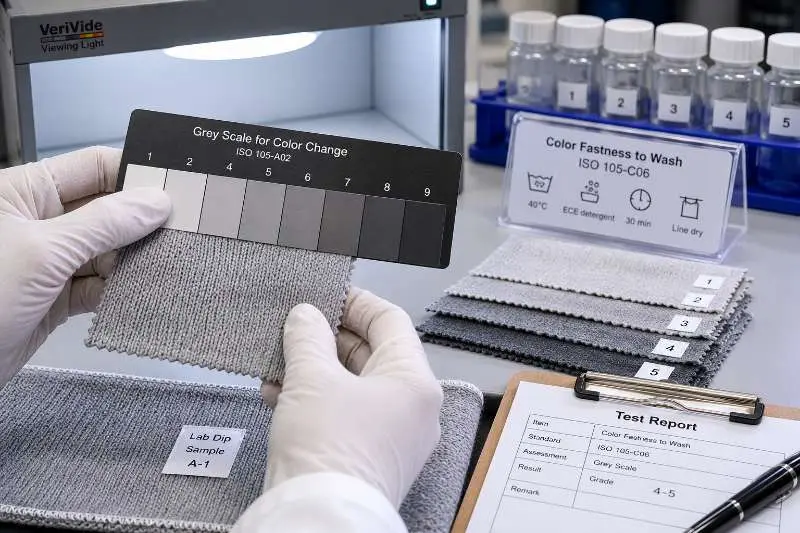
AATCC TM195 test report: Request the actual test data, not just a "moisture wicking" label. AATCC TM195 can be used to evaluate liquid moisture management behavior in textile fabrics, but the acceptance range should be defined in your own bulk approval spec rather than treated as a universal activewear threshold.
Wash durability: If the fabric relies on a hydrophilic finish, ask for post-wash test results that match your product’s expected care and wash-cycle requirement. If the mill cannot supply this data, treat the wicking claim as unverified for long-cycle-use products.
Fiber content and cross-section type: Confirm whether the wicking comes from the fiber geometry or a surface treatment. Ask for the fiber cross-section specification if using modified polyester or nylon.
OEKO-TEX® Standard 100: OEKO-TEX® Standard 100 certified options are available. Please confirm certification requirements at the time of sampling, especially if the fabric uses a functional finish for skin-contact apparel.
GSM range and construction consistency: Specify a target GSM range rather than a single number. Confirm that bulk production tolerances are defined — a GSM variance of ±10% across rolls affects both performance and cutting yield.
Care label alignment: Some fabric softeners can affect finish-based moisture-management performance. If the fabric uses a hydrophilic finish, confirm care restrictions with the testing lab or finishing supplier before finalizing the care label.
Performance context: Wicking is one of two parallel functional dimensions in activewear fabric specification. For buyers also evaluating air permeability alongside moisture management, the technical interaction between construction openness and air permeability of knit fabric is worth reviewing as a related sourcing dimension. Similarly, for broader program-level sourcing decisions across performance categories, activewear fabric sourcing covers how wicking specs integrate into full-range development.
FAQ
Can I request an AATCC TM195 test report for a specific knit construction before placing a bulk order?
Yes, and you should. Reputable production partners may maintain AATCC TM195 or related moisture-management test data for active fabric constructions. When requesting reports, specify whether you need pre-wash results only or post-wash durability data across a defined number of cycles. For finish-based wicking fabrics, post-wash results are the more relevant figure for long-cycle-use product categories.
What MOQ applies to custom moisture-wicking knit fabric in solid colors?
For custom solid-color development, the MOQ for moisture-wicking knit fabrics starts at 300 kg per color. For orders using in-stock constructions, the minimum is 25 kg. Lead times vary depending on whether the construction requires custom fiber sourcing or can be produced from stock yarn — confirm this at the sampling stage.
Does GRS certification apply to moisture-wicking recycled polyester knit fabrics?
Global Recycled Standard (GRS) certification applies to fabrics produced from verified recycled fiber content — including recycled polyester. If your sourcing requirements include both moisture-wicking performance and recycled content traceability, these specifications can be combined in a single development, provided the recycled fiber meets the required cross-section or finishing specification for wicking performance. Confirm certification scope with the production partner during development.
Sourcing Moisture Wicking Knit Fabric: A Three-Variable Decision
Wicking performance in knit fabric is the output of three independent variables working together: the fiber type, the knit construction, and the finishing method applied. Getting one right while leaving the other two unspecified is how bulk orders end up with fabrics that perform inconsistently across colorways or lose function after a season of use.
The fiber sets the baseline — hydrophobic synthetics wick inherently; natural fiber blends generally require a finish to match that baseline. The knit structure determines how efficiently the moisture moves once it reaches the fabric — open-structure mesh accelerates spreading and evaporation; tighter constructions trade speed for stability. The finishing method determines durability across the product lifecycle — fiber-inherent performance persists; finish-based performance requires verified wash durability data before it can be relied upon as a spec.
Specifying all three dimensions at the development stage, and requesting AATCC 195 test reports that reflect them, is what separates a verified performance claim from a marketing description. For brands building activewear or performance categories with defined wash-cycle requirements, this distinction is worth building into every sampling brief. Specifying moisture-wicking knit fabric for your next bulk order? Request a sample with AATCC 195 test data, or get a quote with your target construction, fiber, and GSM range.


 Technical Know-How