BlogFabric for Activewear: How Brands Verify Breathability, Wicking and Stretch Before Bulk Sampling
Fabric for Activewear: How Brands Verify Breathability, Wicking and Stretch Before Bulk Sampling
May 22, 2026
Table of Contents
Key Sourcing Takeaways
Breathability, moisture wicking, and stretch recovery are independent performance variables — each requires its own test specification, not a general "performance fabric" call-out.
Mesh breathability is structural; pique wicking is finish-dependent and degrades with washing; nylon-spandex recovery must be measured after repeated stretch cycles, not on a fresh swatch.
Opacity failure in light-coloured nylon-spandex is best caught by testing the fabric under wearing tension — a static swatch test is not sufficient.
Colorfastness to perspiration (ISO 105-E04, both acid and alkali) is the non-negotiable baseline test for any skin-contact activewear fabric.
Activewear sourcing failures rarely happen because a brand chose the wrong fiber category. They happen because the right fabric was ordered without verifying whether its performance specs actually hold under production conditions. Breathability, moisture wicking, and stretch recovery each require a separate line of verification — none of them can be reliably judged by handling a pre-production swatch. This guide outlines how brands approach that verification across the three knit structures most commonly specified for activewear: knitted mesh, pique knit, and nylon-spandex knit.
Why Fabric for Activewear Demands Spec Verification, Not Just Fiber Selection
Knowing that nylon dries differently from cotton, or that mesh usually allows more airflow than compact knit structures, is baseline knowledge — not a sourcing decision. What separates brands that receive consistent bulk from those that issue claims is whether performance parameters were specified in writing before sampling was confirmed.
Three performance dimensions need to be treated as independent variables:
Breathability is primarily a structural property in knit fabrics — hole geometry, loop density, and fabric weight all affect air permeability. Finishing may affect hand feel, drying behavior, or surface performance, but airflow still depends mainly on mesh openness, yarn size, and loop density.
Moisture wicking describes how quickly moisture migrates from one fabric surface to the other, and how fast it then evaporates. Wicking finishes applied during dyeing or finishing can degrade after repeated washing. A wicking rate measured on a fresh swatch may not reflect performance after 30 wash cycles. For a closer look at fiber structure, finishes, and wash durability, see moisture wicking in knit fabric.
Stretch recovery is not synonymous with stretch. A fabric can elongate substantially in four directions and still lose a meaningful share of its recovery rate after repeated mechanical stress — particularly at higher wash temperatures. Elastane content guides recovery potential, but the relevant measurement is recovery percentage after a defined number of stretch cycles, not elongation alone.
Brands sourcing fabric for activewear should specify these three dimensions in their tech packs before approving a sample. A vague call-out such as "moisture-wicking stretch fabric" leaves all three parameters to the fabric producer's discretion — and production fabric should be evaluated against the specifications the brand actually defines, not against a general performance claim.
Knitted Mesh Fabric — Breathability Structure and What to Check at Sampling
Among all knit structures used in activewear, Knitted mesh fabric is one of the clearest activewear structures where breathability is mainly driven by construction rather than by a finishing claim. The open hole geometry allows direct air exchange between the skin and the exterior environment, which makes mesh the default choice for panels in training tops, running vests, and high-exertion performance garments.
However, not all mesh structures perform equally. Hole size, hole distribution density, and the weight of the surrounding yarn all affect air permeability. Two mesh fabrics that look similar on a swatch can have measurably different airflow rates. When sampling mesh for activewear, brands should request an air permeability test result expressed in L/m²/s — this gives a comparable, standardized metric across different mesh constructions rather than relying on visual or hand-feel assessment. If the design team is comparing power mesh, sport mesh, or lining mesh, see mesh fabric types compared before finalizing the structure for panels or full-body activewear applications.
Additional checks at the sampling stage:
Snag resistance: open-loop mesh structures are inherently more vulnerable to snagging than closed-knit structures. If the end product involves contact with hook-and-loop fasteners, zippers, or abrasive surfaces, request a snag resistance result (Mace snag test or equivalent) before confirming bulk.
Dimensional stability after washing: mesh structures with looser loop tension can distort after repeated laundering. A pre-shipment wash test at the specified care temperature helps identify this before production fabric is cut.
Opacity: mesh is by definition semi-open, but opacity requirements vary significantly by garment type. A running vest tolerates lower opacity than a training shirt or sports bra. Confirm opacity against a background at the garment's intended light exposure conditions.
Close-up of open-hole knitted mesh fabric structure showing hole geometry for sportswear panels
Pique Knit Fabric — Moisture Management and Surface Durability for Performance Tops
Pique knit is commonly specified for performance polos and uniforms because its raised texture creates a more structured surface than flat jersey. For sourcing teams, the key point is not texture alone: fiber content, knit density, and wicking finish determine whether moisture moves through the fabric after repeated washing. However, Piqué's wicking performance is as much a function of fiber composition and finishing as it is of construction. A pique knit fabric in 100% polyester with a wicking finish will manage moisture very differently from a cotton-polyester blend pique with no finish — even if both have the same GSM and stitch structure.
The key sourcing verification for Pique centres on wash durability of wicking performance. Wicking finishes applied during fabric processing are not permanent. The standard question — "Is this fabric moisture-wicking?" — needs to be followed by: "after how many wash cycles, at what temperature, and tested against which standard?" Brands ordering pique for performance uniforms or polo shirts specified for repeated industrial laundering should request wash durability data, not just a wicking test result from an unwashed sample.
Surface durability is the second priority. Pique's raised texture is also its wear risk: the protruding loops are more susceptible to pilling and abrasion than flat interlock or jersey surfaces. For activewear applications, request a pilling resistance result (Martindale or ICI Pilling Box at the cycle count appropriate to your end-use classification) and an abrasion resistance result if the garment will see high-contact use.
Composition note: polyester-dominant pique generally offers better moisture wicking and faster dry time; cotton-dominant pique offers better hand feel and breathability but slower drying. Blended constructions require checking that wicking performance is not compromised by the cotton content absorbing and retaining moisture rather than transporting it.
Nylon-Spandex Knit — Stretch Recovery, Opacity and Fiber Composition Checks
Nylon-spandex knit is the predominant construction for close-fit activewear — leggings, sports bras, compression shorts, and training tights. Its combination of nylon's abrasion resistance and smooth hand feel with elastane's stretch and recovery makes it the standard against which other activewear constructions are measured. Sourcing nylon fabric for this category involves three checks that do not apply to the same degree in mesh or pique sourcing: recovery rate, opacity, and colorfastness to perspiration. For Runtang nylon fabric, available knitted nylon constructions cover 150–600 GSM, with stretch level, fiber ratio, color, and finish confirmed before sampling.
Stretch recovery is the most commonly under-specified parameter. Elastane content influences the ceiling of recovery potential, but actual recovery in finished fabric depends on the knit structure's loop tension, the nylon denier, and how the fabric is finished. Recovery rate should be measured as a percentage of original dimensions after a defined number of stretch cycles — not as a single elongation measurement on a fresh sample. For leggings and compression garments, meaningful recovery loss after repeated cycling can be noticeable to the end wearer and contribute to garment returns.
Opacity is a recurring quality issue in light-coloured nylon-spandex for activewear. Fabric that appears fully opaque on a static swatch may become semi-transparent under tension during wear. The correct approach is to evaluate opacity while the fabric is stretched to its intended wearing tension — not in a flat, unstretched state. This is particularly relevant for lighter shades (white, pastels, light grey) where opacity failure is most visible.
Colorfastness to perspiration (ISO 105-E04) is the most relevant durability test for close-fit activewear worn against skin. Perspiration contains both acidic and alkaline components; both conditions should be tested. A fabric that passes general wash colorfastness (ISO 105-C06) may still show bleed on perspiration testing, which has direct implications for consumer wearability and brand liability.
Spec Checks Brands Should Lock In Before Confirming Fabric for Activewear Orders
The sampling stage is the best point to correct performance deviation before bulk fabric cost, dyeing schedules, and cutting plans are locked. Once bulk fabric is produced, the options available to a brand shrink dramatically. The following four checks should be locked into the sampling brief before any fabric for activewear order is confirmed:
Breathability: for mesh, specify air permeability in L/m²/s. For pique and nylon-spandex, breathability is primarily managed through construction and composition — confirm these are specified, not left to the producer's standard option.
Wicking rate and wash durability: require the wicking test result to be from a washed sample (minimum 5 cycles at care label temperature), not an unwashed sample. State the required wicking standard (AATCC 195 or equivalent) in the tech pack.
Stretch recovery: specify recovery percentage after a defined number of stretch cycles at a defined elongation percentage. This should be treated as a pass/fail criterion, not a reference measurement.
Colorfastness to perspiration (ISO 105-E04, both acid and alkali): non-negotiable for skin-contact activewear. A minimum rating of 3–4 on the grey scale is standard for most retail and brand requirements.
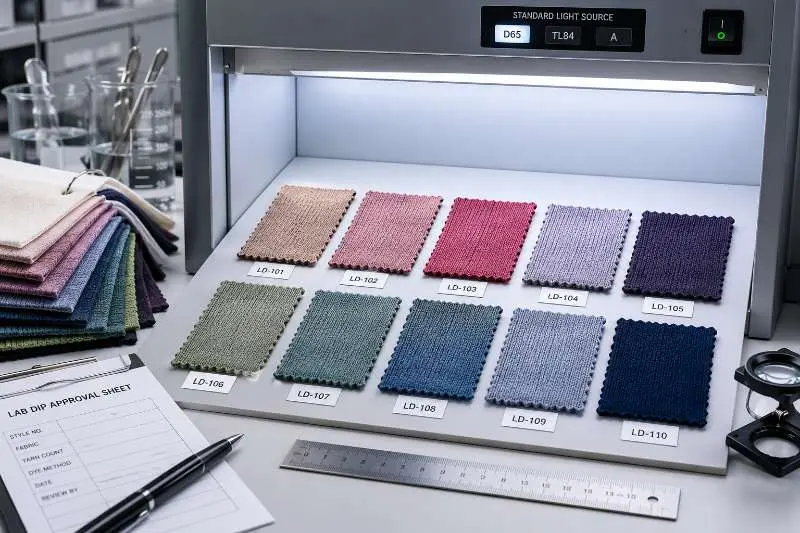
Beyond these four performance checks, lab dip approval and bulk-to-sample consistency on GSM, shade, and hand feel should be confirmed as separate sign-off stages before production release. A performance fabric that passes all functional tests but arrives 15 GSM lighter than the approved sample may still result in rejected goods.
Quick Reference: Verification Points by Fabric Type
Check Point
Knitted Mesh
Pique Knit
Nylon-Spandex Knit
Primary performance check
Air permeability
Wicking durability
Stretch recovery + opacity
Breathability driver
Open-hole structure
Knit texture + density
GSM, density, and construction
Moisture check
Drying behavior if the finish is claimed
Wicking rate after wash cycles
Wicking rate and dry time after wash cycles
Stretch direction
2-way or 4-way
Usually limited stretch
4-way often required
Opacity risk
Expected openness
Low to medium
Must verify under tension
Colorfastness priority
ISO 105-E04 if skin contact applies
ISO 105-C06 + ISO 105-E04 if worn against skin
ISO 105-E04, acid and alkali
Typical application
Panels, vests, training tops
Performance polos, uniforms
Leggings, sports bras, tights
For skin-contact activewear, OEKO-TEX® STANDARD 100 can support harmful-substance safety requirements because the standard tests textile products against harmful substances and applies stricter requirements for more intensive skin contact.
FAQ
What GSM range is appropriate for activewear performance tops versus compression leggings?
For performance tops and training vests, lighter fabric weights — generally below 200 GSM depending on construction — are preferred to allow easier air circulation and reduce garment weight during high-exertion activity. Compression leggings and sports bras typically use heavier, denser constructions for the required support and reduced sheerness. The exact GSM suitable for a given end-use should be confirmed based on the specific fabric construction; the same GSM in mesh versus nylon-spandex interlock produces very different garment performance.
Can activewear fabric be sourced with GRS certification?
Yes. Global Recycled Standard (GRS) certified options are available for recycled nylon and recycled polyester constructions commonly used in activewear. GRS certification covers the recycled content claim from raw material through to finished fabric and requires third-party verification at each stage. Brands requiring GRS documentation should specify this at the inquiry stage, as certified and non-certified material runs are kept separate at the production level.
What is the minimum order quantity for custom activewear fabric development?
Minimum order quantities for custom activewear fabric development vary based on construction complexity, fiber specification, and whether custom colorways are required. For standard constructions in stock compositions, sampling can typically be arranged in smaller quantities; custom development with specific fiber blends or performance finishes carries higher minimums at the bulk stage. Contact the production team with your full spec sheet — including fiber content, GSM target, stretch requirement, and certification needs — to receive an accurate MOQ and lead time.
Ready to specify fabric for your activewear line? Share your performance requirements and we'll confirm available constructions, certifications, and sampling lead times. Request a sample or get a quote to begin the verification process.


 Sourcing Guide