BlogPower Mesh Fabric: What Your Spec Sheet Gets Wrong About Compression
Power Mesh Fabric: What Your Spec Sheet Gets Wrong About Compression
May 21, 2026
Table of Contents
Most spec sheets for power mesh list one number — GSM — and stop there. That single figure tells buyers very little about whether the fabric will deliver the compression force, stretch recovery, or wash durability a garment actually needs. The variables that drive performance in power mesh are structural, not just about weight, and getting them wrong at the sampling stage costs time and margin at bulk.
Power Mesh Fabric vs Standard Knit Mesh: Construction Differences That Affect Spec
Power mesh fabric and standard open-knit mesh share a surface resemblance but are engineered differently. Standard sport mesh — as used in jersey panels or ventilation inserts — typically uses a looser, larger-hole construction with minimal spandex content. The structure prioritises airflow over support, and the fabric has limited recovery after repeated stretching.
Power mesh uses a finer, denser knit construction with a higher spandex content. The tighter loop formation and elevated elastomer ratio are what generate the compressive force. This is a technical distinction that should appear on any B2B spec sheet, not just the end-use label.
The practical difference for brand buyers is significant. Specifying a fabric by end-use category — "mesh for activewear" — without specifying hole density, knit gauge, and spandex percentage means the sample you approve and the bulk you receive may behave differently. The construction variables, not the category name, determine performance.
At Runtang, our knitted mesh fabric range covers both open sport mesh and higher-density power mesh constructions. Understanding which structure your application requires is the starting point for a spec that holds through bulk production.
GSM Range, Hole Density and Compression Force: How Construction Variables Interact
GSM is a useful reference point, but in power mesh, it is the outcome of several interacting variables, not the input. Hole density, yarn count, and spandex ratio all affect the final gram weight, and two fabrics at the same GSM can produce very different levels of compression.
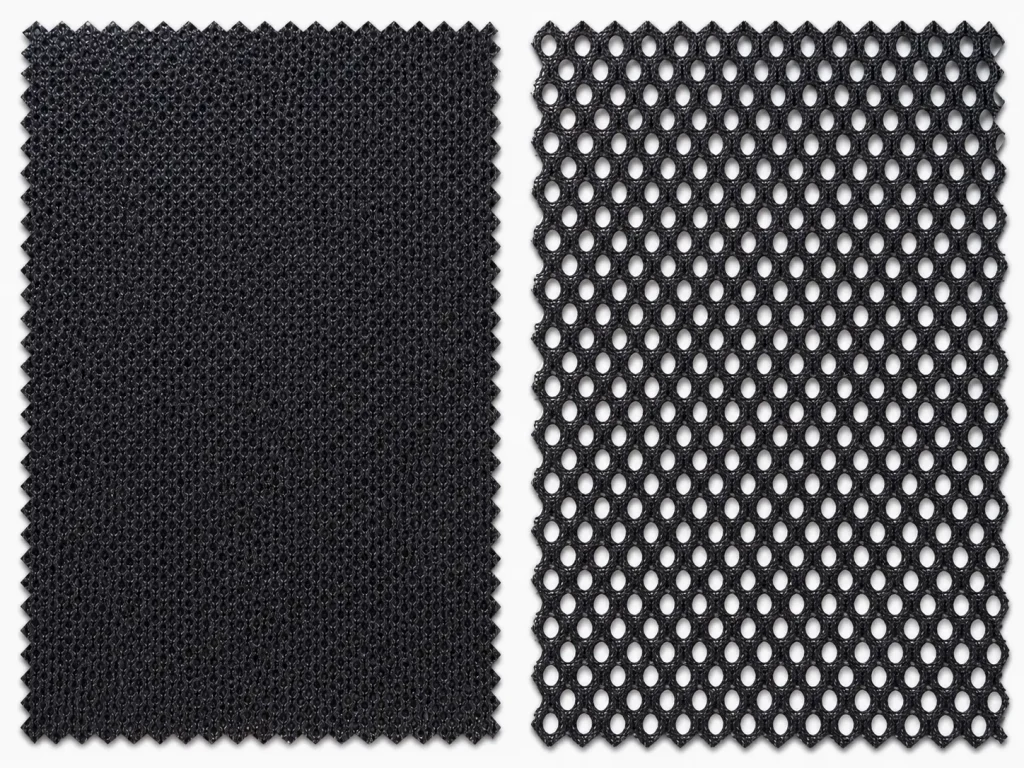
As a directional reference, power mesh used in full-fabric compression applications — sports bras, compression shorts, shapewear linings — tends to fall in a higher GSM range with tighter hole geometry and spandex content that can approach 20–30%, depending on construction. Fabrics intended for ventilation panel use sit at lower weights with coarser holes and lower spandex content, prioritising airflow over compressive recovery.
Application
GSM Direction
Hole Density
Spandex Direction
Full compression (bra, shorts)
Higher
Fine/tight
Higher
Panel/ventilation insert
Lower
Coarser / open
Lower
Lining/support layer
Medium
Fine/medium
Medium-high
Directional parameters only. Actual specs depend on construction and finishing — confirm at the sampling stage.
The point is not to memorise a GSM band, but to understand that specifying only GSM gives a supplier too much latitude. A complete spec for power mesh should include: GSM, spandex percentage (or range), hole size direction (fine/medium/coarse), and intended application. This gives your factory a meaningful brief to work from.
Side-by-side swatch comparison of fine-hole high-compression power mesh vs open-hole sport mesh panel fabric
Fiber and Denier: Nylon vs Polyester and Spandex Ratio Effects on Recovery
Power mesh fabric is predominantly produced in two base fiber options: nylon (polyamide) and polyester, each combined with spandex. The fiber choice affects hand feel, recovery speed, dye uptake, and long-term wash durability in ways that are relevant to bulk performance.
Nylon power mesh tends to offer a softer hand feel against skin and slightly faster recovery after stretch, which is why it remains the more common choice for compression and skin-contact applications. It also accepts dye more evenly, which matters for shade consistency in bulk production. Polyester power mesh is typically more cost-effective, offers good dimensional stability, and performs well in high-wash-cycle applications where shape retention is the priority.
Denier — the linear weight of the yarn — affects both handle and durability. Finer denier yarns produce softer, more lightweight mesh with a smoother surface. Heavier denier constructions produce a more structured, durable fabric that holds shape under higher stress. For most activewear compression applications, fine-to-medium denier nylon is the directional starting point; for support layers requiring higher abrasion resistance, medium denier polyester options may be appropriate.
Runtang produces a range of nylon fabric constructions including mesh variants suited to performance applications. Denier selection and spandex ratio can be adjusted during the sampling stage to match your compression spec requirements.
One variable brands often overlook is spandex degradation over wash cycles. A power mesh that tests well at the sampling stage can lose measurable compression force after repeated laundering if the spandex content or finishing is not appropriate for the wash programme. This is why specifying the expected wash cycle count as part of your brief — not just the initial stretch spec — is relevant when discussing bulk requirements with your factory.
Bulk Approval Checks: Stretch Recovery, Shade Consistency and Snag Resistance
Power mesh has specific properties that require focused QC attention before bulk approval. Three areas warrant particular attention.
Stretch Recovery
Stretch recovery — the fabric's ability to return to its original dimensions after repeated extension — is the defining performance parameter for compression applications. Elastic fabric performance should be checked against agreed stretch and recovery methods. ASTM D4964, for example, covers tension and elongation testing for elastic fabrics made with elastomeric yarns, making it more relevant than GSM alone when evaluating power mesh for compression use. For bulk approval, the relevant question is not just whether the fabric passes at sampling, but whether the recovery spec is maintained across the full production run and after the wash cycles relevant to your end-use.
Power mesh presents shade consistency challenges that solid jersey or interlock does not. The semi-transparent structure means that dye depth, yarn lustre, and even slight variation in spandex tension during dyeing can produce visible shade differences between rolls — or between the face and reverse of a reversible garment. For bulk orders, requesting shade band samples before production approval and specifying an acceptable Delta E tolerance in your purchase order is standard practice for brands working with mesh fabrics at scale.
Snag Resistance
Fine-knit mesh constructions are more vulnerable to snagging than dense knit fabrics. For activewear applications involving hook-and-loop closures, zippers, accessories, or repeated abrasion points, snag resistance should be discussed with the buyer’s testing lab before bulk sign-off. ASTM D3939/D3939M is a textile-relevant snagging method, but open constructions such as power mesh may require an alternative method such as AATCC TM65 or a buyer-approved internal test.
Our full range of knitted mesh fabric options — including power mesh constructions in nylon and polyester — is available for sampling. Fabric hangers and bulk quality approval workflows can be aligned to your specification requirements at the development stage.
For brands sourcing lining fabrics to pair with mesh outer layers, our tricot fabric range provides warp-knit options with good dimensional stability and compatibility with power mesh cutting specs.
FAQ
What GSM range is suitable for power mesh in compression applications?
GSM alone is not a sufficient spec for compression applications. Compression force is driven by spandex ratio, hole density, and knit construction, not weight alone. As a directional reference, higher-compression applications typically use a tighter, heavier construction than panel or lining uses — but the right spec should be confirmed through sampling against your garment engineering brief rather than selected from a weight band. Discuss your application requirements at the sampling stage to align fabric construction with your compression target.
Can power mesh fabric be supplied with OEKO-TEX® Standard 100 certification?
OEKO-TEX® Standard 100 certified options are available. Please confirm certification requirements at the time of sampling. Not all constructions or colourways carry certification as standard, so confirming scope and availability before bulk commitment is the correct process. If recycled nylon or recycled polyester is required, the certification scope should be confirmed separately during sampling.
Runtang manufactures power mesh and knitted mesh fabric across a range of constructions, denier options, and spandex ratios. Request a sample or get a quote to start your sourcing process.

 Fabric Guide

