BlogTerry Cloth for Garment Brands: GSM Bands, Loop Height and Absorbency Trade-offs
Terry Cloth for Garment Brands: GSM Bands, Loop Height and Absorbency Trade-offs
May 20, 2026
Table of Contents
Terry cloth often appears in sourcing briefs with mixed meanings: towel fabric, woven terry, loopback knit, or velour-finish terry. For garment brands, the key decision is not the name itself, but whether the GSM band, loop height, absorbency level, and shrinkage behavior match the intended apparel category before sampling.
Terry Cloth in Garment Production: Scoping the Right Construction First
Terry cloth is not a single fabric. The term covers a range of looped constructions that differ in structure, weight, and intended application. In garment production, three constructions are most relevant: loopback terry (smooth face on one side, loops on the reverse — the standard base for sweatshirts and hoodies), velour-finish terry (the loop face is sheared to produce a flat, pile-like surface, used in premium tracksuits and resort styles), and woven terry (double-loop construction on both faces — primarily associated with towels and bathrobes, and rarely specified in garment production orders).
For garment production, knit-based terry constructions are usually the more practical default. They can support stretch recovery, controllable loop structure, and repeatable fabric development when GSM, fiber blend, dyeing requirements, and finishing parameters are confirmed during sampling and bulk approval. Woven terry at high GSM values is generally outside the garment production range — its weight and structural rigidity exceed what most garment silhouettes require.
Establishing which construction is being sourced should happen before any GSM discussion begins. The same weight number can mean very different things across loopback, velour-finish, and woven terry — and misaligning construction with end-use creates specification errors that are difficult to reverse after sampling. Runtang's terry knitted fabric covers loopback and velour-finish constructions across multiple GSM ranges for garment production.
Terry Cloth GSM Bands by Garment Category
Once the construction type is confirmed, GSM selection depends on garment category and seasonal positioning. The bands below are directional references; final weight will vary depending on construction and finishing, and should be confirmed at the sampling stage.
Lightweight (approx. 180–260 GSM)
Appropriate for summer resort wear, cover-ups, and short-sleeve casual styles where drape and breathability take priority over absorbency. At this weight, terry cloth sits close to a structured jersey in overall garment weight, with the loop texture providing visual and tactile differentiation. Fiber blend matters more at lighter weights — cotton-dominant constructions may require pre-shrink treatment to maintain dimensional stability across production.
Mid-weight (approx. 260–350 GSM)
The most widely used range for garment production. This band covers sweatshirts, hoodies, joggers, and co-ordinate lounge sets — substantial enough to hold construction, light enough for year-round use in most markets. French terry knitted fabric typically sits at the lower-to-mid portion of this range; fuller loopback terry with a deeper loop profile occupies the upper portion.
Heavyweight (approx. 350–500 GSM)
Used in outerwear-weight sweatshirts, premium co-ords, and resort styles where additional hand-feel depth is part of the brand positioning. At this weight, shrinkage behavior and loop stability across wash cycles require close attention during sampling. As a sourcing comparison, waffle fabric can be reviewed as a textured loungewear alternative when buyers want visible surface structure but do not need the same absorbency profile as looped terry.
Loop Height and Absorbency: The Trade-off That Decides Bulk Suitability
Loop height is the structural variable that most directly controls absorbency in terry cloth — and it is also the variable most frequently left unspecified in sourcing briefs.
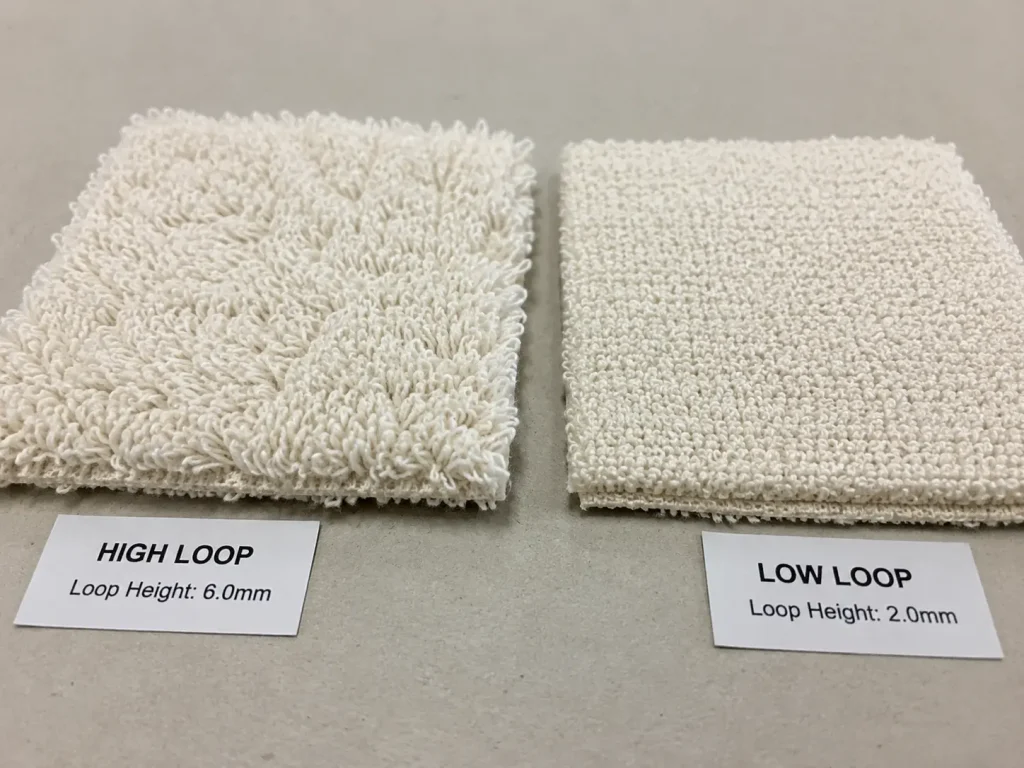
Taller loops provide more fiber surface area in contact with moisture, increasing both absorption rate and total moisture capacity. Shorter, tighter loops produce a denser, more dimensionally stable face with lower absorbency but better resistance to loop pull-out and surface distortion across wear and washing cycles.
For garment categories, these trade-offs have direct practical implications. A beach cover-up or resort polo benefits from moderate loop height — enough to manage post-swim moisture without the bulk associated with full-height loopback construction. A sweatshirt or hoodie lined with terry benefits from shorter, tighter loops that hold structural integrity across repeated wash cycles. Velour-finish styles, where the loop face is sheared, move absorbency to a secondary concern — surface pile evenness and consistency of shear become the primary quality markers instead.
Loop Profile
Absorbency
Dimensional Stability
Typical Garment Use
Taller loops
Higher
Lower
Cover-ups, resort wear, spa garment styles
Mid-height loops
Moderate
Moderate
Hoodies, sweatshirts, lounge sets
Shorter / tighter loops
Lower
Higher
Structured garments, velour-finish terry styles
Loop height should be specified in the sampling brief and physically verified at the sample stage. Request comparative swatches across at least two loop profiles before confirming bulk production parameters.
Two terry cloth fabric swatches showing different loop heights and surface texture comparison
What to Verify Before Bulk Terry Cloth Production
With the GSM band and loop profile confirmed at sampling, the following checks should be completed before releasing bulk production.
Loop uniformity across the roll
Inconsistent loop formation leads to shading variation in dyed fabric that becomes visible in finished garments under even light. Verify roll-to-roll loop consistency during lab dip review, not after bulk delivery.
Shrinkage behavior
Cotton-dominant terry cloth may undergo significant dimensional change after laundering. Specify pre-shrink treatment requirements at the sampling stage and request test data referencing AATCC Test Method 135 — the standard method for dimensional change in textile laundering — rather than estimating behavior from fiber content alone.
Color consistency in loop-structured fabric
The looped face absorbs dye differently from a flat-knit surface. Lab dip sign-off should include loop-face comparison alongside smooth-face swatches for mid-to-heavyweight constructions. Color deviation that is acceptable on flat fabric may appear more pronounced in a loop texture.
Fiber content and certification
OEKO-TEX® Standard 100 certified options are available for terry knit fabric. Please confirm certification requirements at the time of sampling.
For garment brands comparing terry cloth against French terry, fleece, and other sweatshirt-category options before placing a sampling order, the hoodie fabric sourcing guide provides a structured pre-sampling framework across multiple construction types.
FAQ
What GSM range is appropriate for terry cloth used in sweatshirt and hoodie production?
For most sweatshirt and hoodie production, terry cloth in the 260–350 GSM range is a directional reference, depending on construction type and loop profile. Heavier constructions above 350 GSM suit premium outerwear-weight styles. Confirm the appropriate weight at sampling, as fiber blend and finishing affect the final measured GSM.
How does loop height affect terry cloth performance in bulk production?
Taller loops increase absorbency but reduce dimensional stability — better suited to resort wear and cover-ups. Shorter, tighter loops are more stable across wash cycles and better suited to sweatshirt constructions and velour-finish styles. Loop height should be specified in the sampling brief rather than left to the mill's default configuration.
Can terry cloth fabric be ordered with OEKO-TEX® Standard 100 certification?
OEKO-TEX® Standard 100 certified options are available. Confirm certification requirements at the time of sampling, as availability may vary by construction and fiber content.
Request Terry Cloth Samples
Looking to request terry cloth samples across different GSM bands or loop profiles? Contact Runtang with your target garment category and production volume to receive a sample set aligned with your sourcing brief.

 Fabric Guide

