BlogFrench Terry vs Fleece: Before You Sample, Read This
French Terry vs Fleece: Before You Sample, Read This
May 15, 2026
Table of Contents
Both fabrics dominate sweatshirt and hoodie programs, and on a finished garment they can look nearly identical. But French terry and fleece follow different finishing routes — and that difference shows up in how consistently your bulk order replicates what you approved at the sample stage. Before you request swatches, here's what the construction difference actually means for production.
Two Fabrics, Two Finishing Routes
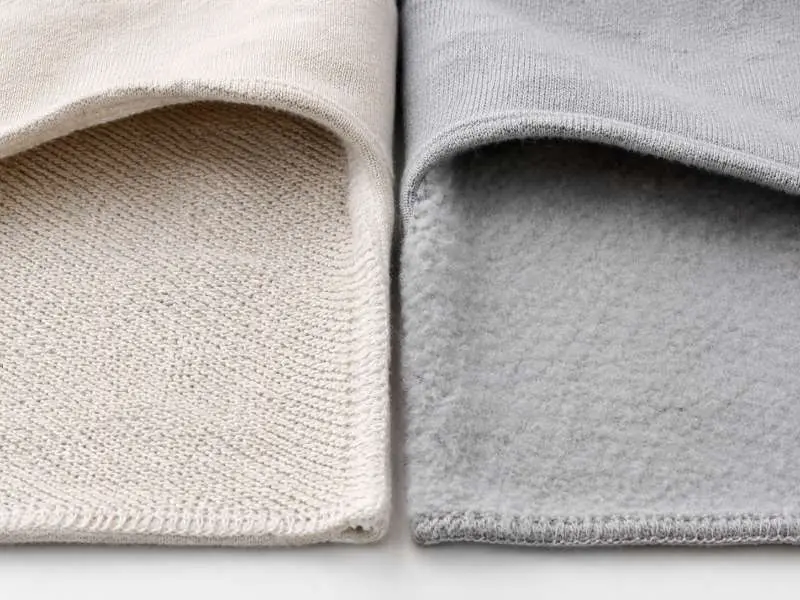
In sweatshirt fabric programs, French terry and brushed fleece are often compared because both are knit structures used for similar garment categories. The difference is in the inner surface and finishing route: French terry knitted fabric keeps a visible loopback interior, while brushed fleece uses mechanical brushing to raise fiber ends into a nap. That extra finishing step changes warmth, shade appearance, shrinkage behavior and bulk inspection priorities.
Because of this, manufacturers treat the two as separate production programs, not interchangeable options. Switching between them mid-season means a different finishing line, different shrinkage behavior, and a different bulk approval timeline — variables worth locking down before sampling, not after.
Feature
French Terry
Fleece
Interior finish
Loops intact (loopback)
Loops brushed into nap
GSM range
220–320 GSM
280–450 GSM
Breathability
Higher
Lower
Warmth
Moderate
Higher
Pilling risk
Lower
Higher (nap surface)
Seasonal positioning
Spring / Fall / transitional
Fall / Winter
GSM Range and Seasonal Positioning
For French terry knitted fabric, GSM determines how much air the loops trap and how the garment drapes. Lighter constructions — roughly 220–260 GSM, depending on fiber blend and construction — suit transitional-season programs. Heavier constructions carry more thermal mass but still allow airflow through the unbrushed loop structure, which is why French terry sits in the year-round layering range for many sweatshirt programs.
Fleece shifts the equation. The brushing process adds perceived warmth beyond what the raw GSM number suggests — a 280 GSM fleece can feel significantly warmer than a 300 GSM French terry because the broken-loop nap traps more heat. When positioning your sweatshirt program by season, the GSM number alone is not a reliable comparison point. The finishing route matters equally.
For brands sourcing polar fleece fabric in heavier brushed constructions, pilling becomes a more important sampling checkpoint because the raised nap is exposed to abrasion. Confirm fiber content, anti-pilling finishing and wash-test results before bulk approval. For a deeper sourcing note, see fleece fabric GSM and pilling risk.
Sampling Checkpoints That Differ Between the Two
This is where the production-route difference becomes a concrete sourcing decision.
For French terry:
Loop consistency: Request a cross-roll inspection. Loop size and density should be uniform from edge to center. Loops that pull out under light tension indicate quality issues that compound in bulk.
Shrinkage pre-treatment: Cotton-rich French terry can shrink depending on fiber content and finishing. Confirm whether the fabric has been compacted, pre-shrunk or heat-set where applicable, and whether your pattern needs size compensation before bulk approval.
GSM tolerance: Confirm the acceptable variance band. A tighter tolerance means more consistent weight and hand feel across your production run.
For fleece:
Nap evenness: Brushing depth can vary between production batches. Request samples from different roll positions, not a single swatch. Nap that is uneven in depth affects both warmth and the visual uniformity of finished garments.
Pilling test result: Fleece's broken-loop surface is more prone to pilling than French terry's intact loops. Confirm the pilling test rating against the standard your brand requires before committing to bulk.
Post-brushing color: Brushing can lighten or alter the perceived shade. Color approval should happen on a brushed sample, not a pre-brushed swatch.
OEKO-TEX® Standard 100 certified options are available. Please confirm certification requirements at the time of sampling, especially when the same program includes both French terry and fleece fabric.
Close-up of French terry loop interior next to fleece nap interior showing texture contrast under studio lighting
Print and Decoration Compatibility
French terry’s smoother outer face is usually easier to stabilize for screen printing, heat transfer and embroidery than a raised fleece surface. However, discharge printing still depends on fiber content, dye system and shade approval, so it should be tested on the actual bulk construction.
Fleece’s nap surface changes the decoration setup. Heat-transfer temperature, pressure and dwell time need testing to avoid pile compression, and embroidery on heavier fleece knit fabric may require additional backing. These are not reasons to avoid fleece for decorated programs, but they should be confirmed during sampling rather than after bulk fabric approval.
FAQ
What GSM range is typical for French terry hoodies in a year-round program?
As a starting reference, cotton-based constructions in the 240–280 GSM range are often considered for three-season hoodie programs, depending on fiber blend, loop density and finishing.
Does fleece pill more than French terry after repeated washing?
Fleece's brushed nap surface generally shows higher pilling tendency than the intact-loop surface of French terry, particularly after repeated machine washing. The degree varies by fiber content, yarn construction, and whether anti-pilling finishing has been applied. For bulk programs with strict wash-durability requirements, request the pilling test result at the sampling stage rather than relying on fiber content alone.
Can the same garment pattern be used for both French terry and fleece versions of a sweatshirt?
Not without adjustment. The two fabrics differ in shrinkage behavior, weight, and drape, which means a pattern graded for one will not translate directly to the other without fit testing. Bulk repeatability depends on fabric-specific pattern grading — align this with your technical team before placing orders in both fabrics simultaneously.
Runtang Tex produces French terry knitted fabric and fleece knit fabric for apparel brands across Europe, North America, and Australia. Request a sample to compare both constructions side by side before your next bulk sweatshirt program.

 Fabric Comparison