BlogFrench Terry Fabric for Hoodies: GSM, Loop Structure, and Shrinkage Control
French Terry Fabric for Hoodies: GSM, Loop Structure, and Shrinkage Control
May 15, 2026
Table of Contents
Specifying the wrong GSM, missing loop inconsistencies at sampling, or skipping pre-shrink checks — any one of these can send a hoodie order back for rework. This guide covers the three sourcing decisions that determine whether your French terry fabric for hoodies performs in bulk: weight selection, loop structure verification, and shrinkage control before production sign-off. For heavier winter programs, fleece knit fabric is usually the warmer brushed option, while French terry remains the cleaner loop-back choice for mid-weight hoodies that need moderate structure.
Choosing the Right GSM for Hoodie Production
GSM is the primary spec variable in French terry for hoodies — it determines structure, drape, and how the finished garment holds its shape across washes. The right range depends on end-use and target market.
GSM Range
Construction
Typical Application
Sampling Note
220–260 GSM
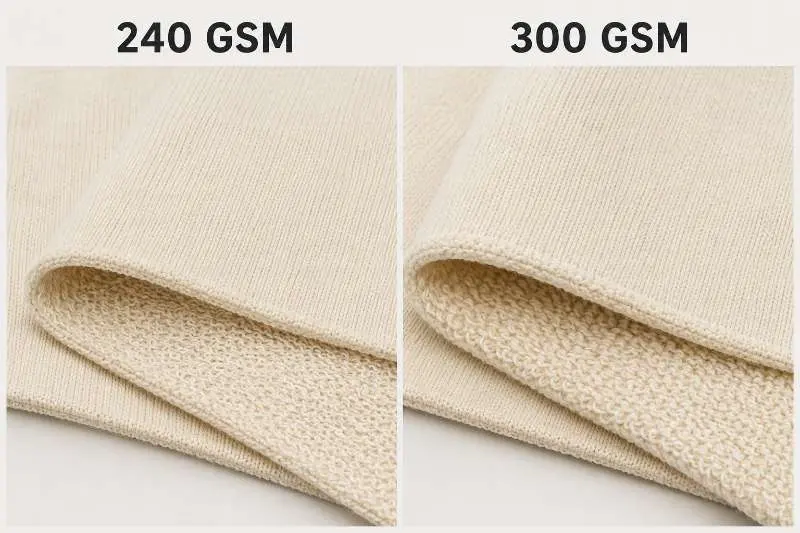
Lighter loop density
Spring/summer hoodies, layering pieces, and children's hoodie programs
Check drape and opacity; risk of insufficient structure for shaped hoods
Common benchmark range for bulk verification; easier to control across repeat orders
300–380 GSM
Denser loop, heavier face
Autumn/winter hoodies, heavyweight streetwear
Request pre-shrink treatment and confirm loop stability under tension
For most apparel brands, the 260–300 GSM range offers the best balance of bulk production consistency and seasonal flexibility. Orders outside this range — particularly above 320 GSM — should include an explicit pre-shrink specification in the purchase order.
Cross-section view of loop density and face thickness variation between 240 GSM and 300 GSM French terry
Loop Structure: What to Check Before Approving a Sample
The loop side of French terry is a key quality point that should be checked during sample approval, not only after lab testing. Compared with towel-style terry knitted fabric, French terry has loops on one side and a smoother outer face, so uneven loop density across a roll can make the hoodie interior feel different from panel to panel and may affect wash durability. Before approving a sample, sourcing teams should verify three points:
Loop uniformity: Gently stretch a 10 cm section in the lengthwise direction. As a quick hand check, gently stretch a 10 cm section in the lengthwise direction. Loops should not pull out easily, and there should be no obvious height variation across the swatch. Localized thinning is a sign of knitting tension inconsistency.
Loop height: Check for consistent loop height across the width of the roll. Request the loop height specification from the mill; any tolerance range should be agreed in writing before bulk production.
Brushing finish: French terry for hoodies can be ordered unbrushed (loops intact, cleaner look) or lightly brushed (softer interior, increased bulk). The choice affects the finished garment's weight and interior texture — specify this explicitly in the tech pack, not just the GSM.
A brushed finish can change the finished fabric's weight depending on brush intensity. If your hoodie spec requires a specific final GSM, confirm whether the quoted weight is measured before or after brushing. This is a sourcing error that is common in early rounds of sampling.
Fiber Blend Options for Hoodie Production: Cotton, Cotton/Poly, and Cotton/Spandex
The fiber composition of French terry for hoodies affects shrinkage behavior, print surface quality, shape retention, and certification eligibility. The three most common blends sourced for hoodie production each carry different trade-offs:
Composition
Shrinkage Profile
Print Suitability
Certification Options
100% Cotton
Higher shrinkage risk — pre-shrink treatment essential for bulk
Excellent for many water-based and pigment print programs when the face yarn, finishing, and curing conditions are confirmed
OEKO-TEX® Standard 100; Global Organic Textile Standard (GOTS), if organic cotton is used
Cotton/Polyester (80/20 or 75/25)
Reduced shrinkage vs. pure cotton; good bulk stability
Good — slightly reduced absorption vs. pure cotton
OEKO-TEX® Standard 100; GRS may be possible when the recycled content, certified supplier, and transaction certificate requirements are confirmed
Cotton/Spandex (95/5 or 92/8)
May shrink more due to elastane relaxation after washing — test at 3–5 wash cycles
Good — smooth face maintained; avoid high-heat curing
OEKO-TEX® Standard 100
For brands with recycled-content targets, French terry containing certified recycled fibers may be eligible for Global Recycled Standard (GRS) certification. In hoodie production, this is often seen in cotton/recycled polyester blends, but eligibility depends on the actual recycled input, certified supplier, and chain-of-custody documentation. Confirm certification before sampling rather than after bulk approval.
Shrinkage Control and Pre-Production Testing
French terry's looped structure makes it more susceptible to shrinkage than flat knits of the same composition — the loops can tighten under heat and mechanical action during washing. For hoodies, where dimensional accuracy at the cuff, hem, and hood opening directly affects fit grading, shrinkage needs to be confirmed before bulk, not estimated.
The standard test for dimensional change in knit fabrics is AATCC TM135 (dimensional changes of fabrics after home laundering). Request this test report from the mill before production sign-off. Key things to specify:
Wash temperature and number of cycles to reflect the end-consumer care label
Whether the fabric has received a pre-shrink or compacting finish — and if so, at what shrinkage tolerance
Lengthwise and widthwise shrinkage should be reported separately, because dimensional change can differ between wale and course directions in French terry
Cotton-dominant blends can experience dimensional change if the fabric has not been compacted or pre-shrunk. The exact shrinkage range depends on yarn count, knit construction, and finishing treatment, so buyers should request test data for the specific production batch rather than relying on category averages.
For bulk orders, also request a lab dip for color before committing to full production. French terry, particularly in heavier GSM, can absorb dye unevenly if the loop density varies across the roll. A lab dip confirmed under the buyer-specified light source, such as D65 when required, reduces the risk of shade variation disputes at goods receipt.
FAQ
What GSM range should I specify for French terry fabric used in structured hoodies?
For a structured hoodie with shaped panels and a fitted hood, 270–300 GSM is the most reliable range for bulk production. Below 260 GSM, the fabric may lack the face density needed to hold the hood shape without canvas or fusible interfacing. Above 320 GSM, shrinkage risk increases and a pre-shrink finish becomes essential. For heavyweight streetwear styles, 300–360 GSM can be appropriate, but confirm loop stability with a multi-wash sample before approving bulk.
Can I get French terry with GRS certification for my hoodie collection?
Yes, if the fabric contains certified recycled input. Global Recycled Standard (GRS) certification traces recycled input material through the supply chain and is available for qualified recycled-fiber constructions, including many cotton/recycled polyester French terry options. Virgin 100% cotton French terry does not qualify for GRS because it does not contain recycled input; if recycled cotton is used, eligibility should be checked through the certified material source and supply-chain documentation. Clarify your certification requirement at the enquiry stage — not all mills hold both GRS and GOTS simultaneously.
Should hoodie brands choose brushed or unbrushed French terry?
Choose unbrushed French terry when the buyer needs a cleaner loop-back interior, better breathability, and a more stable finished GSM. Choose lightly brushed French terry when a softer handfeel and more insulating interior are the priority. Confirm whether GSM is measured before or after brushing, because brushing can change the finished weight and bulk.
What shrinkage tolerance should be confirmed before bulk hoodie production?
Do not rely on a generic category number. Ask the mill to state the accepted tolerance in lengthwise and widthwise directions after the agreed wash method and cycle count. For cotton-heavy French terry, confirm compacting or pre-shrink treatment before production sign-off, especially for cuffs, hems, and hood openings.
Ready to Sample French Terry for Your Hoodie Line?
We manufacture French terry fabric across multiple GSM ranges and fiber compositions, with OEKO-TEX® Standard 100 and GRS options available when certification requirements are confirmed before sampling. Request a sample from our French terry range or send your spec for a quote — MOQ from 25 kg for stock colors.

 Sourcing Guide

