BlogKnit Fabric Defect Claims: Documentation, Inspection Reports, and Resolution Workflow
Knit Fabric Defect Claims: Documentation, Inspection Reports, and Resolution Workflow
May 29, 2026
Table of Contents
Key Sourcing Takeaways
A valid fabric defect claim requires roll number, batch reference, photographic evidence, and an inspection report — verbal reports alone are not sufficient to initiate resolution.
Inspection reports using the 4-point system give both parties a quantifiable basis for assessing defect severity; claims without standardized scoring are difficult to evaluate.
Resolution outcomes — replacement, credit, or price adjustment — are determined by the confirmed defect rate against the agreed tolerance specified in the original purchase order.
Pre-shipment inspection, conducted before goods leave the production facility, is the most effective tool for preventing fabric defect disputes before they arise.
A fabric defect claim without the right documentation rarely reaches a clear resolution. Whether the issue is a needle line running through 200 meters of knit fabric or uneven dyeing across an entire batch, what determines the outcome is not the severity of the defect — it is the completeness of the evidence submitted. This guide covers what to document, how inspection reports are assessed, and what resolution paths look like in practice.
What Makes a Fabric Defect Claim Actionable
Not every defect report becomes a processable claim. For a fabric defect claim to move forward, it needs to establish three things: which specific rolls or batches are affected, what type of defect is present, and how widespread the problem is. Without these elements, neither the buyer nor the manufacturer has a factual basis to assess responsibility or agree on a remedy.
The minimum documentation for a valid claim includes:
Batch and roll identification: roll numbers, purchase order (PO) number, and delivery note reference — these trace the affected fabric back to a specific production run and dye lot.
Photographic evidence: close-up images of the defect with a ruler for scale, a full shot of the roll label showing roll number and meter count, and a wider shot showing the defect in its surrounding context.
Defect description: defect type (e.g., dropped stitch, needle line, uneven dyeing), estimated frequency per roll, and approximate linear meters affected.
Inspection reference: whether the inspection was conducted by the buyer's internal team, a third-party agency, or at the point of receipt, and the date it was completed.
Timeline matters. Defects reported within 24–48 hours of receipt carry more procedural weight than those reported weeks later, because early reporting reduces ambiguity about whether the issue occurred during transit or post-delivery. For latent defects — those only visible after cutting or washing — the reporting window is longer, but lab test documentation becomes essential to substantiate the claim.
The volume of fabric in dispute also shapes the resolution path. A claim covering two rolls out of 200 is evaluated differently from one covering 80 rolls. Being precise about which rolls are affected — using roll numbers rather than estimates — strengthens the claim considerably and enables accurate batch tracing.
How Inspection Reports Are Structured and Evaluated
An inspection report is the core document in any fabric defect claim. Without one, a claim is a complaint; with one, it becomes a structured dispute that can be measured against agreed specifications.
The most widely used grading framework is the 4-point system (referenced in ASTM D5430), in which defects are assigned penalty points based on their size:
Defect Length
Penalty Points Assigned
Up to 3 inches
1 point
Over 3 inches, up to 6 inches
2 points
Over 6 inches, up to 9 inches
3 points
Over 9 inches, or holes
4 points (maximum per linear yard)
The 4-point system is one of the most common frameworks for fabric defect grading. It assigns penalty points by defect size and reports results as points per 100 square yards or 100 square meters. Some buyer-supplier agreements use 40 points per 100 square yards as an acceptance reference, but the actual tolerance should be confirmed in the purchase order before production begins.
An effective inspection report includes: inspection date, name of inspector or inspection agency, fabric style and PO reference, quantity inspected in meters or kilograms, roll-by-roll defect point totals, calculated points per 100 square yards, and a pass or fail conclusion against the agreed tolerance.
Third-party inspection reports from agencies such as SGS, Intertek, or Bureau Veritas carry more procedural weight in disputed claims because they are conducted by an independent party. Internal buyer inspection records are useful as a starting point, but if a claim escalates, a third-party report is typically required to progress toward a formal resolution.
Common documentation gaps that weaken a claim: missing roll numbers in the inspection report, defect descriptions without photographs, no reference to an agreed tolerance in the PO, and inspection records produced after rolls have already been cut into production.
How Defect Type Changes the Evidence Required
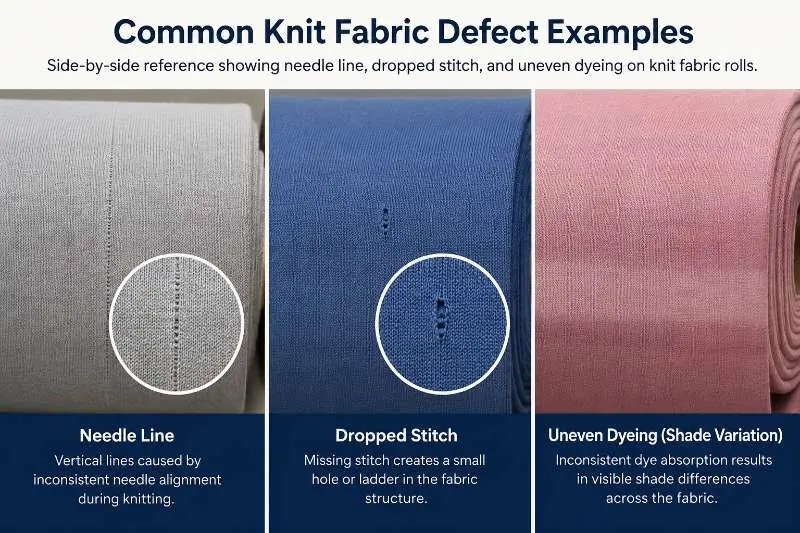
Knit fabric defects generally fall into two claim categories: visible defects and latent defects. Visible defects are issues that can be identified during fabric inspection or when the rolls are first received. Common examples include needle lines, dropped stitches, holes, barre, contamination, and noticeable shade variation. Because these defects are observable before production, buyers should document them as early as possible. Useful evidence typically includes roll numbers, defect photographs, video records, inspection reports, defect measurements, and any applicable scoring results from the agreed inspection method. Clear documentation helps establish that the defect existed before the fabric entered the cutting or sewing process.
Latent defects are more complex because they may not become apparent until the fabric has been processed, washed, dyed, printed, or used in production. Examples include excessive shrinkage, dimensional instability, spirality, skewing, shade change after washing, poor colorfastness, or performance issues that only appear under specific conditions. Since these defects are not always visible during receipt inspection, claim evaluations usually require stronger technical evidence. Supporting documents may include wash test reports, laboratory test results, shade assessments, production records, and retained fabric samples from the affected batch.
The type of defect directly affects the level of evidence needed to support a claim. For visible defects, inspection records and photographs are often sufficient to demonstrate the problem. For latent defects, however, both parties may need to review testing data and production history to determine whether the issue originated in the fabric itself or resulted from cutting, sewing, finishing, washing, storage, or handling after delivery. Providing complete and traceable documentation makes it easier to identify the root cause, evaluate responsibility, and reach a fair resolution.
Side-by-side examples of common knit fabric defects including needle line, dropped stitch, and shade variation
The Resolution Workflow: From Claim Receipt to Decision
When a fabric defect claim is received, the resolution process moves through defined stages. Each stage depends on the information from the previous one, which is why documentation completeness at submission directly affects how quickly and clearly a resolution can be reached.
Claim received and logged. The claim is cross-referenced against production batch records using the roll numbers and PO reference provided. This step confirms whether the affected rolls can be traced back to a specific production run, dye batch, or knitting cycle. Claims without roll-level identification may require additional back-and-forth before this step can be completed.
Defect type and scope verified. The reported defect type is compared against the pre-shipment inspection record and the original fabric specification sheet. If the defect was present at the point of shipment and was not recorded in the pre-shipment inspection, this affects how responsibility is assessed. If no pre-shipment inspection was conducted, this stage relies entirely on the buyer's inspection documentation.
Responsibility assessed. There are three possible origins for a fabric defect. A raw material issue — such as yarn quality inconsistency — originates before knitting. A production process issue — such as needle damage or tension inconsistency — occurs during knitting or finishing. A post-shipment issue — such as moisture exposure or compression damage — occurs after the fabric leaves the production facility. Each scenario points to a different resolution path.
Resolution path determined against the agreed acceptance criteria. The defect score for affected rolls is compared against the acceptance criteria agreed in the purchase order. If the defect rate is within tolerance, the rolls may be accepted as-is or with a partial credit for confirmed defective lengths. If the defect rate exceeds the agreed tolerance, resolution may involve replacement of affected rolls, a price adjustment applied to the remaining order balance, or — in cases where fabric cannot be used — a return and credit for the affected quantity.
Corrective action documented. Regardless of the resolution outcome, the affected batch is flagged in production records. A corrective action note identifies the root cause and the production adjustment made to prevent recurrence. This record is available to the buyer on request and provides evidence that the issue has been addressed at the production level, not just resolved for the immediate order.
Pre-Shipment Inspection as the Most Effective Claim Prevention
The most practical way to reduce fabric defect claims is to catch issues before goods leave the production facility. A pre-shipment inspection — conducted after finishing and before packing — allows both parties to agree on fabric quality while the rolls are still at the factory, which eliminates the ambiguity that makes post-delivery claims harder to resolve.
At Runtang Tex, greige fabric undergoes roll-by-roll inspection as part of the standard knit fabric quality control process, with defect points recorded per roll before fabric enters dyeing and finishing. Finished fabric is inspected again before packing, and inspection records are available alongside the shipment documentation. This documentation chain — from knitting through finishing to dispatch — allows specific batch issues to be traced accurately if a claim arises.
For brands with strict quality requirements, specifying the acceptance tolerance in the purchase order before production begins is the most effective way to establish a clear basis for any future claim. This includes the points-per-100-square-yards threshold, wash shrinkage limits, and shade pass criteria. Without agreed specifications in writing, determining whether a defect is within or beyond acceptable limits becomes a negotiation rather than a factual assessment — and negotiations take significantly longer to resolve than documented disputes.
OEKO-TEX® Standard 100 certified options are available. Please confirm certification requirements at the time of sampling. For fabric defect claims, certification documents should be treated as supporting compliance records, not as a substitute for roll-level inspection reports, defect photos, shade records, or lab test results. Further details on our production background and certifications are available on the About page, and our full knitted fabric range is available for sample requests.
Frequently Asked Questions
What documents should I include when submitting a fabric defect claim?
At minimum: roll numbers and PO reference, photographic evidence of the defect with the roll label visible, an estimate of the affected quantity in meters or kilograms, and the date of inspection. An inspection report — internal or third-party — that records defect type and defect points per roll significantly strengthens the claim. For latent defects only visible after washing or cutting, a lab test report is required, as visual inspection alone is not sufficient to substantiate dimensional or dyeing issues.
How does a knit fabric defect claim differ from a garment defect claim?
A fabric defect claim addresses the raw material before it has been cut and sewn, which means the defect can often be traced directly to a specific production batch or dye lot. A garment defect claim is typically assessed against AQL sampling of finished goods. For fabric claims, roll-level documentation is the key evidence; for garment claims, defect count across a statistically valid random sample determines the outcome. The earlier in the production chain a defect is identified, the more straightforward the resolution — and the lower the cost of remediation on both sides.
Runtang Tex manufactures knitted fabrics for apparel brands across Europe, North America, and Australia, with inspection records available for confirmed bulk orders upon request. Request a fabric sample or get a quote to start your sourcing process.

 Manufacturer Insights

