BlogJacquard Pattern Development for Knit Apparel: Repeat, Yarn Selection and Sampling Realities
Jacquard Pattern Development for Knit Apparel: Repeat, Yarn Selection and Sampling Realities
May 28, 2026
Table of Contents
Key Sourcing Takeaways
Repeat size is a cost variable: a larger jacquard pattern repeat increases float length, yarn waste at roll edges, and machine setup complexity — decisions made in the brief stage, not the sampling stage.
Yarn count direction determines motif clarity: finer-count yarns generally produce sharper jacquard pattern edges, but require closer machine gauge matching; mismatches show up in the first strike-off.
Color count drives sampling rounds: each additional yarn color in a knit jacquard introduces a new float management layer, which is why 2–4 color configurations are the practical range for most bulk programs.
Knit jacquard briefs and woven jacquard briefs are not interchangeable: loop structure gives stretch but limits fine repeat precision — brands switching from woven to knit need to adjust repeat expectations before development begins.
A jacquard pattern that looks precise on screen can still trigger avoidable sampling rounds when repeat size, yarn direction, and color count are left open. These are not only design choices. They are production inputs that should be confirmed before development starts.
Why Jacquard Pattern Repeat Size Is a Cost Variable, Not Just a Design Choice
The repeat unit in a jacquard pattern — the smallest design module that tiles across the fabric — determines far more than visual rhythm. In knit jacquard, every repeat boundary is a point where the machine must manage float yarns: the non-knitted strands that travel across the back of the fabric between motif areas. Longer floats increase the risk of snagging during cut-and-sew and can affect the hand feel of the finished fabric. Shorter repeats that tile densely demand tighter needle sequencing and can limit how many colors are practically usable per row.
For brands, the practical implication is this: a jacquard pattern with a large repeat — say, a wide intarsia-style motif intended to span across a garment section — requires more needle involvement per row than a small, dense geometric tile. That can increase programming review time, machine setup complexity, and material planning pressure when the repeat does not align well with usable fabric width or garment panel layout. These are not arbitrary factory decisions. They follow directly from the repeat dimensions specified in the design file.
The sourcing checkpoint here is not technical: it is organizational. Repeat dimensions — horizontal width and vertical height of the tile — should be confirmed in the brief, not discovered during the first strike-off. If your design team uses centimeters and your factory programs in stitches per gauge, that conversion gap is a common source of the first revision cycle. Providing both the visual file and a written repeat specification in the same unit system removes one of the most frequent early-stage delays in knit jacquard development.
Yarn Selection for Knit Jacquard — What Drives Motif Clarity and Float Control
The clarity of a jacquard pattern depends on how well the selected yarn matches the machine gauge, repeat size and color layout. Finer yarns can support cleaner motif edges because each knitted loop carries less visual weight, while heavier yarns often create a softer boundary between color areas. For small text, fine geometric motifs or tight repeat spacing, yarn direction should be reviewed before strike-off.
Color compatibility matters as much as the main yarn choice. In a 3-color or 4-color jacquard pattern, yarns should stay within a compatible count and twist range so tension does not shift visibly at motif edges. Float behavior should also be checked against the selected fiber and finishing route, because reverse-side tension may change after finishing. For brands comparing jacquard knit fabric options, yarn selection should be confirmed before the first sample, not corrected after the motif already looks distorted.
A close-up of the reverse side of a jacquard knit fabric, revealing the floats spanning the patterned areas
Sampling Stages for Knit Jacquard — Where Approvals Slow Down and Why
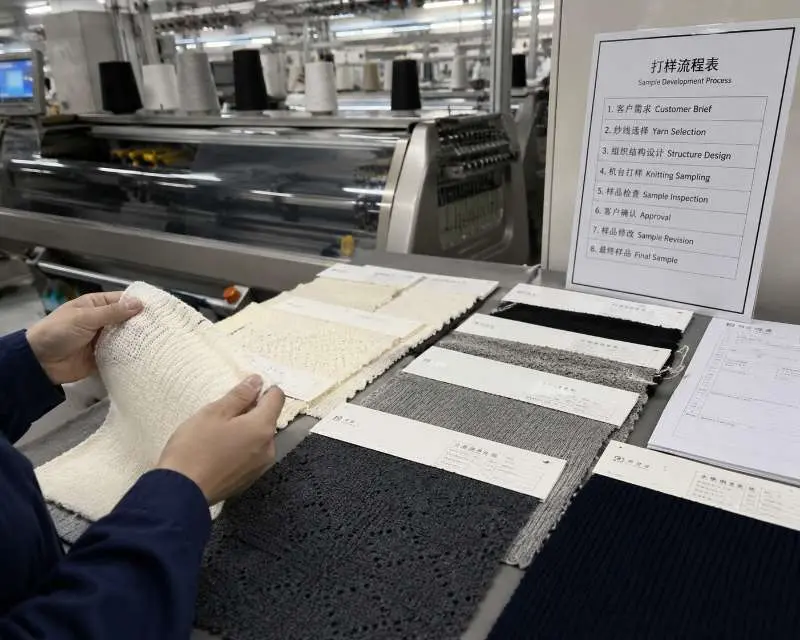
Knit jacquard development follows a predictable stage sequence, and the slowdowns at each stage are also predictable once you know where the decision points sit.
The process begins with a digital design file being programmed into the machine's control system. The factory converts the visual pattern into a needle-action sequence specific to the gauge and color configuration. This is why virtual sampling for jacquard patterns can help clarify pattern structure, yarn behavior and machine programming before physical sampling begins. The first physical output is usually a strike-off or trial panel, depending on the machine route and sample scope. This is the first physical reference point where visual approval can happen.
The most common reasons a strike-off triggers a revision request, rather than approval, fall into three categories:
Color float exposure: the non-knitted yarn traveling between motif areas on the reverse side is longer than expected, creating snag risk or surface bulge. This is resolved by adjusting the repeat spacing or inserting additional float anchoring rows — both of which require re-programming and re-running the sample.
Repeat alignment shift: the motif tiles do not align cleanly across the fabric width, producing a visual stagger that was not present in the design file. This is often a gauge conversion issue or a machine tension setting that needs calibration at the start of the production width.
Color boundary softness: the transition between two adjacent colors in the jacquard pattern is blurrier than intended, typically caused by yarn count mismatch between the two colors or a float anchoring point that is too close to the motif edge.
After strike-off approval, development moves to a production sample — a full-width panel produced on the production machine at production tension. This is where hand feel, drape, and finished weight are properly evaluated, as short strike-off samples do not always reflect the behavior of the full-width fabric after finishing. Approval at this stage clears the development for bulk. Depending on pattern complexity and colorway count, this sequence can take varying amounts of time; programs with 2 colors and a small geometric repeat typically move faster than those with 5 colors and a large-scale motif. For context on how double knit fabric construction affects structural stability in similar development scenarios, the product page is a useful reference.
The practical takeaway for sourcing teams: each revision round adds time. If the brief resolves repeat dimensions, yarn specifications, and color count before development begins, the path from file submission to bulk approval is materially shorter than if those decisions are left open for the factory to interpret.
Jacquard Pattern in Knit vs Woven — What Buyers Get Wrong When Switching
Brands that move a woven jacquard pattern into knit development often expect the same edge sharpness, but the structure works differently. Woven jacquard carries the pattern through warp and weft interlacing, while knit jacquard builds the motif through selected needles and loop formation. Because loops have stretch and lateral movement, fine lines, small text and sharp diagonal edges may look softer in knit form.
The sourcing checkpoint is to review the motif before sampling. Horizontal and vertical geometric patterns usually translate more cleanly into knit jacquard. Fine script, photographic gradients and very small details may need simplification, repeat adjustment or a different production route. For a broader view of how a brief moves into sampling, see the custom knit fabric development process.
What a Complete Jacquard Pattern Brief Should Cover Before You Send It
A complete jacquard pattern brief should answer the key production questions before programming starts. Keep it short, but make the inputs clear:
Repeat dimensions: state the horizontal and vertical repeat size, preferably in both centimeters and stitch count if available.
Color count and sequence: confirm how many yarn colors are used and whether strong color changes sit next to each other in the same row.
Yarn direction: define the preferred fiber type, yarn count direction and any known performance requirements.
Application and GSM direction: explain the garment type and target weight range so the factory can judge gauge and yarn suitability.
Reverse-side tolerance: confirm whether the back side will be visible, because float length and reverse yarn color may affect approval.
These details do not limit the factory's development work. They reduce interpretation during programming and help the first strike-off match the buyer's design intent more closely.
FAQ
How does the color count in a jacquard pattern affect sampling lead time?
Each additional yarn color in a knit jacquard design introduces a new float management layer that the machine must handle on every row where that color appears. A 2-color jacquard pattern is significantly simpler to program and calibrate than a 5-color one, and the strike-off is more likely to be approved in fewer rounds. Brands with compressed development timelines should factor color count into design decisions early — reducing from 5 colors to 3, for instance, can materially shorten the programming and calibration phase. The relationship is not linear, but the direction is consistent: fewer colors, fewer variables, faster approvals.
Can a jacquard pattern be developed on circular knit fabric, or is flat knit required?
Jacquard patterns can be executed on both circular and flat knitting machines, and the choice is typically determined by the end-use construction rather than the jacquard requirement itself. Circular knit jacquard is suited to jersey-based programs — cut-and-sewn apparel where the tube is opened and laid flat. Flat knit jacquard is more common in full-fashioned knitwear such as sweaters, where the panel is knitted to shape. The design file requirements differ between the two machine types, so the brief should specify which production route is intended. A design that works on one machine type may require adjustment before it can run on the other.
Start Your Jacquard Development with the Right Inputs
Runtang Tex produces jacquard knit fabric for apparel brands sourcing structured knitwear and patterned jersey. If you have a design file or an early-stage brief, request a sample or get a quote to begin the development review.


 Manufacturer Insights