BlogWhich Print Method Works Best on Custom Knit Fabric? Reactive, Pigment and Sublimation Compared
Which Print Method Works Best on Custom Knit Fabric? Reactive, Pigment and Sublimation Compared
May 27, 2026
Table of Contents
Key Sourcing Takeaways
Reactive printing is the default for cotton-based knit constructions — it bonds dye into the fiber, preserving stretch and hand feel through bulk production.
Sublimation printing only works on custom knit fabric with high polyester content; cotton or natural fiber knits need another print route.
Pigment printing offers the widest substrate compatibility but introduces hand feel changes at heavier ink coverage — verify on a sample before approving bulk.
Confirming print method at the fabric development stage, not post-production, avoids resampling costs and delivery delays.
Choosing a print method for custom knit fabric is not a finishing decision — it is a fabric specification decision. The wrong pairing between printing process and knit construction can mean uneven dye penetration, stiffened hand feel, or color inconsistency across production batches. Sourcing teams that lock in the print method before sampling avoid the most common reorder complications.
How Knit Structure Shapes Custom Knit Fabric Print Compatibility
Unlike woven fabrics, knit constructions — including single jersey, interlock, and rib knit — have inherent elasticity from their loop-based structure. This creates two practical constraints on printing:
Ink or dye must accommodate stretch without cracking or separating from the substrate during garment use.
The surface texture of the knit affects print resolution: tighter constructions such as interlock, produce sharper edges, while looser loop structures may soften fine detail.
Beyond stretch, fiber content is the primary variable that determines which print method is technically viable. A 100% cotton jersey knit fabric and a 95% polyester performance knit require fundamentally different dye chemistries. Specifying the construction and fiber content up front is therefore a prerequisite — not a detail to confirm later in the sampling process.
GSM also plays a supporting role. Heavier-weight knit fabrics (depending on construction and finishing) may require adjusted ink viscosity or extended fixation time to ensure even penetration. These are variables that a knit fabric development team should account for at the print specification stage.
Reactive Printing: The Cotton-Knit Default for Apparel Brands
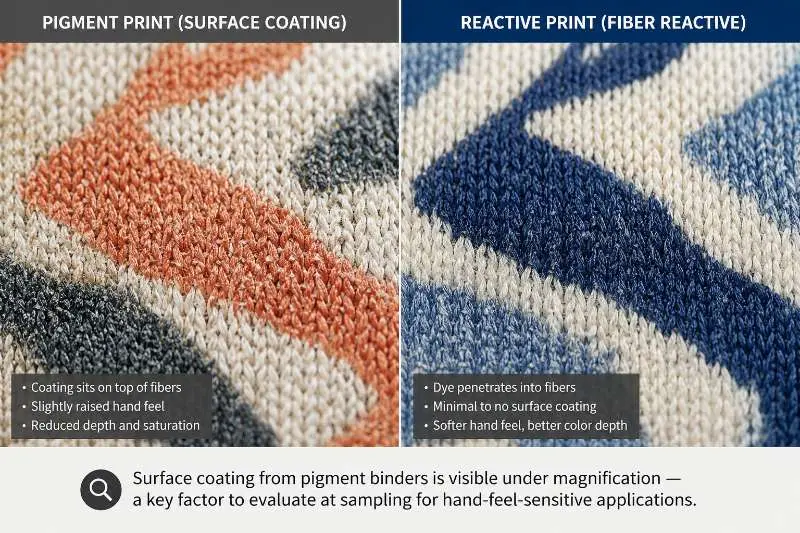
Reactive printing is the standard method for natural fiber knit constructions, particularly cotton and cotton-blend jerseys. The dye forms a covalent bond with cellulose fibers, which means it becomes chemically integrated into the fabric rather than sitting on the surface. For apparel brands producing T-shirts, casualwear, or loungewear on cotton-based knits, this results in:
Preserved hand feel — reactive dyes do not add a coating layer, so the fabric retains its natural drape and stretch behavior.
Strong wash fastness — once the dye is fixed and excess removed, color retention through repeated washing is generally reliable.
Good color depth — reactive dyes support complex colorways and photographic prints, particularly on lighter-ground fabrics.
In bulk production, the main sourcing consideration with reactive printing is batch consistency. Dye lots can vary between production runs due to differences in water chemistry, temperature, or fixation time. When placing bulk orders, buyers should request a specified acceptable shade band in writing — for example, a tolerance level measured against the approved sample — and confirm this before signing off on production. This is especially relevant for reorder programs where visual consistency across seasons is required.
Reactive printing is less effective on high-polyester substrates. Cotton content may need to be above a certain threshold (depending on construction) for reactive dyes to bond effectively. For blended knits, the actual cotton percentage in the blend should be confirmed before selecting this method.
Pigment Printing: Broader Substrate Range, Different Trade-offs
Pigment printing differs from reactive printing in a fundamental way: the colorant does not bond chemically with the fiber. Instead, a binder system adheres pigment particles to the fabric surface. This distinction has direct implications for sourcing decisions:
Substrate flexibility — pigment printing can be applied across a range of fiber types, including cotton, polyester, and blends, without the chemistry constraints of reactive or sublimation methods.
Simpler setup — no steaming or washing-off steps are required after fixation, which can reduce lead time in some production contexts.
Hand feel impact — because a binder layer is present on the fabric surface, heavier ink coverage can introduce perceptible stiffness. The degree of this effect depends on the binder formulation and ink volume, and it varies by fabric weight and construction.
For bulk orders on knit fabrics, the critical verification point is wash fastness. Pigment prints that are not properly heat-set can show color degradation after multiple wash cycles. Buyers should request wash fastness test data — preferably to ISO 105-C06 or equivalent — for the specific fabric and ink combination before production approval.
Pigment printing is most suitable for straightforward graphic applications, limited colorways, or situations where substrate flexibility is more important than premium hand feel. For fine-gauge knits used in next-to-skin applications, the hand feel trade-off should be evaluated carefully at the sampling stage.
A Close-up Comparison of the Surface Textures of Pigment-Printed and Reactive-Printed Knitted Fabrics
Sublimation on Custom Knit Fabric: Polyester Constructions Only
Dye sublimation converts solid dye into a gas under heat and pressure, embedding the colorant directly into polyester polymer chains. On custom knit fabric, this produces prints with exceptionally high color saturation, smooth gradients, and no perceptible hand feel change — because nothing is added to the fiber surface.
The hard constraint is fiber content. Sublimation dyes require a polyester substrate to bond with. In practice, this means:
Fabrics with high polyester content are required for full color vibrancy. The effective threshold can vary by construction, yarn blend, dye formulation, and color depth, so the final base fabric should be tested before bulk approval.
Cotton knits and natural fiber constructions cannot accept sublimation dyes. Any cotton present in a blend will appear as undyed or washed-out areas in the print.
Performance knit fabrics used in activewear and sportswear collections — typically high-polyester constructions — are the primary application for this method.
For brands sourcing performance fabrics for training or sport applications, sublimation is often the preferred route for all-over print designs. The print withstands repeated washing and physical stress without cracking, provided the base fabric is correctly specified.
One practical sourcing note: sublimation is a pre-cut process applied to fabric rolls or finished panels before garment assembly. The heat application must be controlled precisely — inconsistent temperature across the width of a fabric roll can produce color variation in bulk. Verifying temperature consistency capability at the production stage is an appropriate quality checkpoint.
What to Verify at Sampling Before Committing to Bulk
Regardless of which print method is selected for a custom knit fabric program, a structured sample approval process reduces production risk. The following checkpoints apply across all three methods:
Color against approved standard: Confirm the printed sample matches the approved color reference within an agreed tolerance. For reactive and pigment methods, this should be checked under multiple light sources (D65, TL84, and UV/A at a minimum) to identify potential metamerism.
Wash fastness rating: Request test results for wash fastness, rubbing fastness, and — for sublimation — light fastness. Target grades should be aligned with the end-use application before bulk approval.
Hand feels after washing: Particularly relevant for pigment printing. Evaluate the fabric sample after a standard wash cycle, not just in its finished state from the mill, to capture any binder softening or stiffness changes.
Batch color consistency commitment: Confirm the acceptable shade deviation in writing — both for the initial production run and for reorders. This is especially important for programs with multiple colorways or planned seasonal rebuys.
If buyers require chemical safety verification for printed apparel fabrics, confirm whether the finished printed article can meet OEKO-TEX® Standard 100 requirements for the intended product class.
For brands managing custom dyeing for knit fabric alongside print programs, the same batch-control logic applies — recipe documentation and shade band management should be consistent across both dye and print development tracks to support reorder continuity.
Print method selection is also connected to the fabric development timeline. Reactive and pigment methods can generally be confirmed earlier in the sampling cycle. Sublimation may require the fabric base to be finalized first, given its strict polyester content requirement. Building this sequence into the sourcing calendar avoids delays at the lab-dip or strike-off stage.
FAQ
Can reactive printing be used on polyester-cotton blend knit fabrics?
Reactive dyes bond with cellulose fibers, so on a polyester-cotton blend, only the cotton portion accepts the dye. The result depends on the blend ratio — at higher polyester content, color depth will be noticeably reduced, and the undyed polyester may create a heathered effect. For blended custom knit fabric, the actual blend ratio should be confirmed before committing to reactive printing. An alternative is disperse-reactive combination printing, though this involves a more complex process.
What is the MOQ for custom print on knit fabric?
MOQ varies depending on the print method and whether the fabric base is sourced from stock or developed to specification. For custom development programs, the general starting point is 300 kg per color for solid custom colors, and 1,000 kg for fully custom construction programs. Print-specific MOQs should be confirmed at the development briefing stage, as they depend on the production setup and the complexity of the colorway.
How does the print method affect wash fastness in bulk production?
Reactive printing generally produces strong wash fastness when dye fixation is properly controlled — color bonded into the fiber is more resistant to laundering than surface-applied colorants. Pigment printing wash fastness depends heavily on binder quality and heat-setting parameters; ISO 105-C06 or an equivalent wash-fastness test is the clearer way to verify this before bulk approval. If chemical safety certification is required, confirm whether the printed article can meet OEKO-TEX® Standard 100 requirements for the intended product class.
Runtang Textile manufactures custom knit fabrics across a full range of constructions and fiber combinations, with print development support available through the sampling process. Request a sample or get a quote to start your print sourcing process.

 Manufacturer Insights

