Leading Knit Fabric Manufacturer
Leading Knit Fabric Manufacturer
Sourcing recycled knit fabric has moved from a brand differentiator to a retailer onboarding requirement. Buyers placing bulk orders today are increasingly asked to produce certification documentation before a purchase order is confirmed. Understanding what is pushing this shift — and what to verify at the fabric level — matters before sampling starts.
First, retailer compliance is becoming more document-led. Many brands and retail programs now ask suppliers to verify recycled-content claims with chain-of-custody evidence before bulk approval. If a fabric claim cannot be supported by scope certificates and transaction records, the order may face extra review rather than a clean approval process.
Second, EU policy is moving toward product-level data transparency. Under the 2024 Ecodesign for Sustainable Products Regulation, the Digital Product Passport is designed to store and share data on product sustainability, durability and environmental aspects. For apparel buyers, this makes material traceability and claim documentation harder to treat as optional.
Third, market data shows why buyers are asking earlier. According to the Textile Exchange Materials Market Report 2025, recycled fibers remained around 7.6% of global fiber production in 2024, while recycled polyester increased from about 8.9 million tonnes in 2023 to about 9.3 million tonnes in 2024. Since recycled polyester is still primarily bottle-based, brands should verify both recycled-content claims and source-material declarations before bulk.
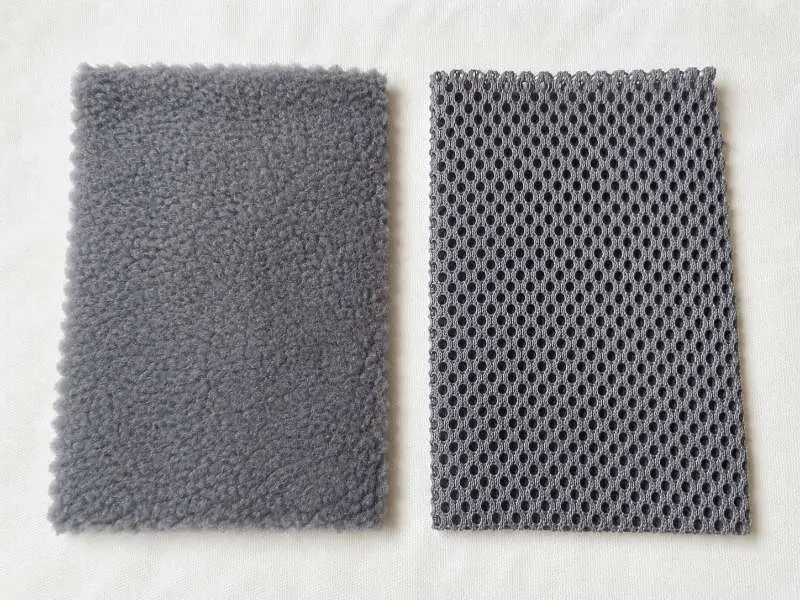
Within recycled knit fabric sourcing, polar fleece made with rPET is one of the more common production routes because recycled polyester has broader commercial availability than recycled nylon and can be adapted across multiple fleece weights. For brands sourcing hoodies, outerwear liners, or casualwear, recycled polyester fleece is often a practical starting point before moving into more specialized mesh or nylon-blend structures.
For sourcing teams, the key verification points are:
Beyond fleece, knitted mesh for activewear is another visible demand area for recycled knit fabric. Recycled polyester mesh and recycled nylon-blend mesh can be used in sportswear panels, yoga apparel, swim-adjacent pieces, and performance linings, but the available certification scope and lead time can vary more than standard polyester fleece. Recycled nylon supply is generally more limited than recycled polyester, so brands should confirm yarn availability, certification scope, and sampling lead time before setting a bulk launch calendar.
The fiber composition in knitted mesh fabric for activewear can vary by construction: some structures use 100% recycled polyester, while others combine recycled nylon with spandex for stretch performance. Confirm fiber content at the yarn stage before committing to a bulk specification.
Key considerations for recycled mesh sourcing:
The verification process for recycled knit fabric differs from standard fabric sourcing in one critical way: certification must be documented across every processing stage in the supply chain, not just at the finished fabric level. The following table summarizes what sourcing teams should confirm for the two recycled knit categories covered in this guide.
| Verification Point | Recycled Polyester Fleece | Recycled Mesh (Activewear) |
|---|---|---|
| Fiber Source | rPET from post-consumer bottles (may vary by mill) | rPET or recycled nylon — confirm per lot |
| Recycled Content for On-Product Label | ≥ 50% for on-product claim | ≥ 50% for on-product claim |
| Certification Scope | Check spinning + knitting + dyeing stages | Check knitting + finishing stages |
| Transaction Documentation | Confirm TC or equivalent transaction documentation for certified bulk claims | Confirm TC or equivalent transaction documentation for certified bulk claims |
| GSM Reference Range | 200–400 GSM (depending on construction) | 100–200 GSM (depending on construction) |
| Color Batch Stability | May vary — request shade band approval | May vary — confirm per bulk run |
Beyond the table above, brands sourcing from our knit fabrics range should confirm: (1) whether certification scope covers both the fabric mill and the dyeing facility, as separate facilities may each require independent certification; and (2) whether the certification body and certificate details can be verified through the current Textile Exchange-recognized documentation process.
GRS operates on a chain-of-custody model: every certified facility that handles the material — from recycler to yarn spinner to knitter to dyer — should be covered by a valid scope certificate. A gap in the certified chain can weaken or invalidate the recycled-content claim at the finished fabric level.
For sourcing teams, this translates into a document checklist rather than a supplier selection shortcut:
It is also worth noting that the recycled content percentage affects what claims a brand can make. Under GRS claim rules, 20–49% certified recycled content can support B2B certification claims, while ≥ 50% certified recycled content is required for consumer-facing on-product labeling. Brands should define their claim requirement before specifying the recycled content target — this affects both the fabric selection and the supplier scope certification requirements.
For brands evaluating the full environmental impact of recycled fiber sourcing, textile carbon footprint considerations — including the difference between bottle-recycled and textile-to-textile recycled polyester — are increasingly part of procurement decisions. Our textile carbon footprint content covers this in more detail for buyers building scope 3 reporting requirements into their sourcing criteria.
The approval process for recycled knit fabric requires a few additional steps compared to standard fabric development:
For brands starting with recycled polyester fleece, the recycled polyester for knit apparel content covers fiber-level specifications, GSM ranges, and certification options in more detail.
Request: (1) a current scope certificate for each certified facility involved in the supply chain; (2) transaction documentation, such as a Transaction Certificate (TC), covering the certified material claim for the bulk order; and (3) a recycled content percentage that matches your spec sheet. These documents help verify the chain of custody before shipment or retailer review.
For most apparel applications, rPET fleece can perform comparably to virgin polyester — but this depends on the specific construction, fiber blend, and finishing process. Pilling resistance and color batch consistency may vary between mills and between recycled content percentages. Always request a pilling test result and shade band before bulk approval, rather than assuming equivalence with virgin polyester specifications from previous collections.
Certified recycled options are available for selected knit fabrics, including polar fleece and performance mesh. Confirm certification scope at sampling, then request a sample or get a quote for bulk sourcing.
Please contact us if you are interested in our products and services.
