BlogCable Knit Fabric Development: What Gauge and Repeat Logic Mean for Your Bulk
Cable Knit Fabric Development: What Gauge and Repeat Logic Mean for Your Bulk
May 19, 2026
Table of Contents
Cable knit fabric development often runs into problems before bulk production begins. If gauge, repeat width, and draw-in are not checked during the technical sample stage, the design may need extra sampling rounds before it can move into bulk. For sourcing teams, these variables should be confirmed before the first sample request is placed.
How Gauge Selection Shapes Cable Knit Fabric Definition and Weight
Gauge, measured by needles per inch on a flat knit machine, is one of the first variables that shape cable definition, fabric weight, and panel stability in cable knit fabric. Lower gauge ranges, such as 5GG to 7GG, can accommodate heavier yarns and produce more visible cable relief for chunky knitwear. Higher gauge ranges, such as 10GG to 14GG, usually require finer yarns and create more compact cable panels. The final result still depends on yarn count, stitch density, and finishing, so gauge should be confirmed with a development swatch rather than selected from a reference image alone.
The relationship between gauge and fabric weight is not linear, and it is also not fixed: GSM can vary depending on construction, yarn twist, and stitch density, so any weight target should be confirmed against a fabric swatch rather than derived from gauge alone. That said, as a directional guide, lower gauge structures in cable knit fabric tend to yield heavier finished weights suitable for outerwear and structured knitwear, while higher gauge constructions produce lighter-weight options more appropriate for layering pieces and mid-season collections.
For development purposes, gauge selection must be confirmed before the tech pack is submitted. Changing gauge after the first sample means resetting machine setup, re-estimating yarn consumption, and in most cases producing a new sample from scratch. The decision is upstream of everything else.
Cable Knit Fabric Repeat Logic: How Panel Width Is Calculated
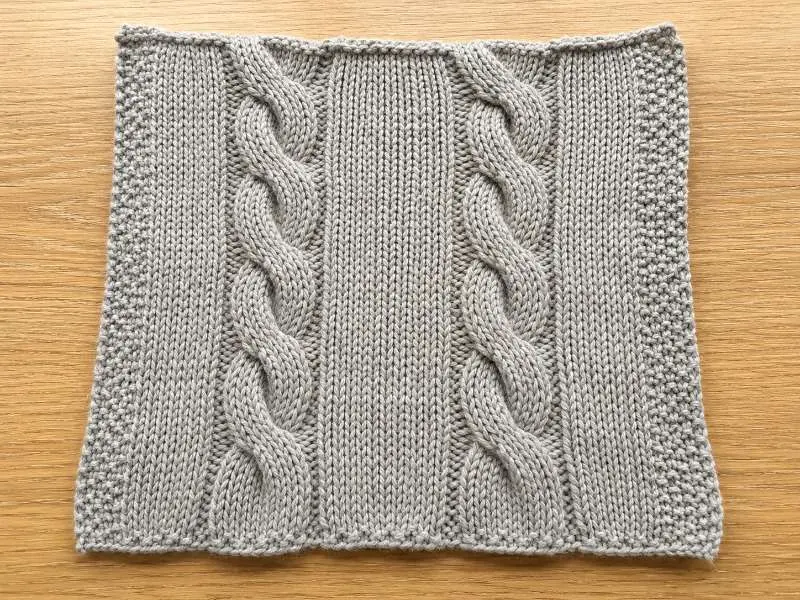
A cable knit fabric design is built from repeating panel units. Each cable panel occupies a fixed number of needles — the repeat width. The total number of repeats across the fabric must fit evenly into the machine's usable needle count, or the design cannot be produced symmetrically. If the repeat does not divide cleanly, the options are to adjust the panel stitch count, modify the number of repeats, or change the target fabric width. None of these adjustments is trivial once sampling has started.
Repeat mismatch is a frequent reason cable samples need revision. A design may look balanced in a sketch or CAD file, but still fail to tile correctly at the intended width if the repeat width does not match the machine setup. Vertical repeat also matters: the more course rows required to complete one cable crossing cycle, the longer the sample length needed before the full structure can be evaluated. For complex cable layouts, the production team should confirm both horizontal and vertical repeats before sampling, just as repeat placement must be checked in jacquard knit fabric development before bulk production.
Close-up of cable knit fabric repeat panel showing stitch crossing and panel width alignment
Draw-In in Cable Knit Fabric: Why Your Panel Runs Narrower Than Spec
Cable knit fabric has a structural characteristic that directly affects bulk cutting and yield planning: it draws in. The cable crossing stitch pulls adjacent loops laterally inward, reducing the fabric's resting width compared to a plain knit structure produced on the same machine at the same gauge. The more cables per unit width, and the more frequent the crossing interval, the more pronounced the draw-in effect.
This means that the width measured on a finished cable knit fabric panel will be narrower than the width of an equivalent plain jersey panel made on the same machine. Development teams that do not account for draw-in when writing the tech pack width specification will receive a first sample that appears too narrow, even though the machine was set up correctly.
Compensating for draw-in requires building an additional width allowance into the machine setup, with the exact amount depending on cable density, crossing frequency, and yarn elasticity. This figure varies by construction and should be confirmed with the production team on a per-design basis — it is not a universal constant that can be applied across different cable patterns. At the bulk scale, draw-in also affects fabric yield per roll, so it should be factored into raw material calculations before bulk fabric quantity is ordered.
Cable Knit Fabric Production Constraints to Confirm Before Bulk
Beyond gauge and repeat, several production-side constraints determine whether a cable knit fabric design can be reproduced consistently across a bulk run. These should be confirmed at the technical sample stage — not after bulk approval. For reference on how gauge and stitch density interact across the full spec sheet, cable knit fabric gauge and stitch density are covered in detail in the corresponding fabric guide.
Panel alignment in cut-and-sew production requires that cable panels at seam points are positioned so that the cable repeat is visually continuous across the join. This places an alignment tolerance requirement on cutting that does not exist for plain jersey or interlock. If the tech pack does not specify cable alignment at seams, garment-level QC will likely flag misalignment as a defect during pre-production approval. The alignment spec must be written in before the sew-by sample is cut.
Yarn twist direction can still affect the visual balance of cable knit fabric, especially in structures where cable relief, surface bias, and recovery are visible after finishing. However, the cable crossing direction itself should be controlled through the approved pattern and machine setup. For reorder consistency, the approved yarn specification, cable direction, gauge, repeat width, and finishing route should all be documented in the production record.
Shrinkage behavior in cable knit fabric is also construction-dependent and should not be assumed from the fiber content alone. Cable structures relax differently from plain structures after finishing, and the degree of relaxation affects final panel dimensions. A post-wash shrinkage test on the technical sample is the appropriate benchmark for bulk tolerances — not a generic fiber-level shrinkage estimate.
At Runtang Textile, cable knit development can be reviewed from gauge selection through repeat confirmation and approved bulk sampling. Our Foshan production base supports custom knit development for apparel brands, with custom solid color MOQ starting at 300 kg per color and custom development orders starting at 1,000 kg. This makes cable knit fabric suitable for brands that need controlled sampling records before placing seasonal bulk orders.
FAQ
What gauge is typically used for cable knit sweater fabric development?
Gauge selection depends on the weight and cable definition required. Lower gauge ranges (around 5GG to 7GG) are commonly used for heavyweight cable constructions with pronounced texture, while mid-range gauges (around 10GG to 12GG) are more appropriate for lighter-weight or finer cable panels. The right gauge for a specific design should be confirmed against a development swatch — gauge cannot be reliably inferred from a reference image alone. If you have a reference fabric or weight target, share it with the development team before the tech pack is finalized.
What should be documented before bulk cable knit fabric production?
Before bulk production, the approved record should include gauge, yarn specification, repeat width, cable direction, finished width, shrinkage result, and color approval status. If certified or recycled yarn is requested, material claim documents should also be confirmed during sampling. Textile Exchange standards can be referenced for chain-of-custody and material claim requirements in responsible sourcing programs.
Working on a cable knit fabric development brief? Share your gauge target, repeat reference, and width specification with our development team. We review tech packs before sampling to identify repeat logic and draw-in issues before they cost a sampling round. Request a sample or get a quote to start.

 Manufacturer Insights

