BlogKnit Fabric Finishing for Apparel: Brushing, Peaching, Mercerizing and Wash — What Each Delivers in Bulk
Knit Fabric Finishing for Apparel: Brushing, Peaching, Mercerizing and Wash — What Each Delivers in Bulk
May 15, 2026
Table of Contents
Writing “soft hand feels” in a tech pack is not a finishing specification. Without naming a process, a factory applies its default finishing — and the default rarely matches a brand’s intent. Brushing, peaching, mercerizing, and wash treatments each produce distinct outcomes on knit fabric, and each carries its own risk profile in bulk production. Specifying the right finishing process — and verifying it on pre-production samples — reduces reorder risk and keeps bulk color and texture consistent across delivery lots.
What Knit Fabric Finishing Actually Controls
Finishing usually happens after knitting and around the dyeing or post-treatment stage, but the exact sequence varies by fiber, construction, and finishing method. For knit fabrics, finishing divides into three categories: mechanical finishing, which uses rollers or abrasive surfaces to alter the physical surface; chemical finishing, which restructures fiber properties through concentrated treatments; and wash finishing, which achieves texture or color effects through controlled agitation. The finishing method must be compatible with the fabric’s fiber content, GSM range, and construction. A process well-suited to a 220 GSM cotton jersey may not be appropriate for a 140 GSM structure, depending on yarn composition and the intensity of the treatment.
Brushing — Loft, Warmth and Fleece Hand Feel
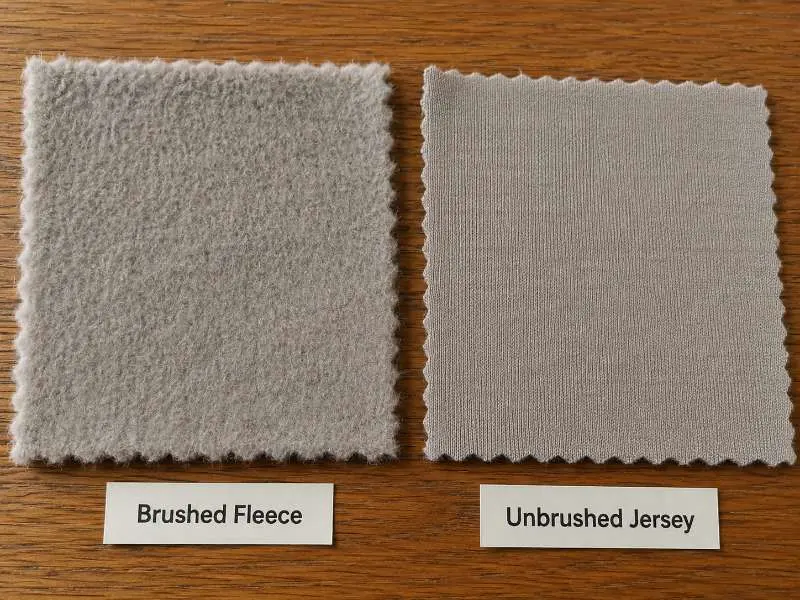
Brushing passes the fabric surface against soft bristle rollers to raise fiber ends, creating loft and a warmer hand feel. It is most commonly applied to fleece knit fabric — including single-faced and double-faced constructions — and to the loop side of French terry, where brushing forms the characteristic insulating interior. On finer jersey, a lighter brushing pass can soften the hand feel without significantly building pile. The primary bulk risk is surface strength reduction: brushed fabrics are more vulnerable to pilling during wear, which is why an anti-pilling finishing step is often specified alongside. Lot-to-lot shade variation can also occur between heavily brushed rolls, especially when brushing intensity changes surface reflection. Buyers should approve a pre-production sample and define acceptable hand-feel and pilling limits before bulk production.
Brushed fleece fabric swatch next to unbrushed jersey showing surface fiber loft difference
Peaching — Dense Suede Surface on Jersey and Interlock
Peaching uses emery-covered rollers to abrade the fabric surface, producing a shorter, denser texture than brushing — the result is closer to suede than to the lofty softness of brushed fleece. It is more commonly applied to finer jersey and interlock structures where the fabric has sufficient body to withstand the mechanical pass. As a reference point, constructions below approximately 130–150 GSM may carry a higher risk of surface disruption, depending on fiber content and yarn twist. Peaching can produce more consistent surface uniformity across the fabric width than brushing, though edge-to-edge variation remains possible on tubular fabrics. High-intensity peaching may trigger pilling on spun cotton structures and should be specified with an intensity level rather than left as an open process description.
The table below compares brushing and peaching across key sourcing dimensions.
Feature
Brushing
Peaching
Surface Effect
Lifted, lofty fiber texture
Short, dense suede-like surface
Common Use
Fleece, french terry, jersey
Jersey, interlock
GSM Guidance
Flexible (depending on construction)
Jersey, interlock; assess lower GSM carefully
Main Bulk Risk
Pilling; lot-to-lot shade variation
Pilling at high intensity
Tech Pack Note
Specify process + add anti-pilling step
Fleece, French terry, jersey
Mercerizing — Luster, Dye Depth and Dimensional Stability
Mercerizing treats cotton fibers with a concentrated alkaline solution under tension. The process restructures the fiber cross-section, producing three measurable outcomes: a silk-like surface luster, improved dye uptake, and better dimensional stability after repeated washing. For apparel brands ordering mercerized cotton knit fabric, this can support deeper solid-color results and more predictable bulk approval, although final shade consistency still depends on dyeing control and lot approval. The process applies to cotton-dominant knit constructions, including jersey, pique, and interlock; it is not appropriate for purely synthetic structures. Treatment conditions may vary depending on the specific construction, so buyers should request a pre-production swatch for color and dimensional verification before committing to bulk.
Wash Finishing — Softening, Surface Effects and Process Control
Wash finishing covers enzyme wash, which softens hand feel by breaking down surface fibers through controlled biological action; stone wash, which creates an aged, irregular surface texture; and effect washes such as mineral wash on knit fabric, which produce characteristic color variation patterns. Of all finishing categories, wash is the most prone to lot-to-lot variation: water chemistry, load volume, agitation intensity, and cycle time all affect the final result. For certification-sensitive orders, OEKO-TEX® Standard 100 certified options are available. Please confirm certification requirements at the time of sampling, especially when wash effects, dye recipes, or special finishes are involved.
Finishing Spec Checklist for Brand Buyers
A finishing spec without sample verification creates production ambiguity. The same process name covers a wide range of intensities, sequences, and outcomes depending on the fabric base. Confirming each parameter before writing a requirement into a tech pack reduces back-and-forth after bulk production has started. The table below summarizes what to verify for each finishing type.
Finishing
Hand Feel Output
Suitable Fabric Base
Primary Bulk Risk
Tech Pack Note
Brushing
Lofted, warm surface
Fleece, French terry, jersey
Pilling; lot shade variation
Name process; add anti-pilling spec
Peaching
Dense, suede-like
Jersey, interlock (>130–150 GSM)
Pilling at high intensity
Specify intensity level
Mercerizing
Lustrous, smooth
Cotton knit (jersey, pique, interlock)
Possible dimensional change
Request pre/post-mercerizing swatch
Wash (enzyme/effect)
Softened or aged surface
Cotton and cotton-blend knit
High lot-to-lot variation
Establish shade band; sample-based approval
FAQ
What is the difference between brushing and peaching on knit fabric?
Brushing uses bristle rollers to lift fiber ends, creating loft and a warmer hand feel, and it is common for fleece and some French terry constructions. Peaching uses abrasive emery rollers for a shorter, denser suede-like surface, more common on jersey and interlock. Both carry a pilling risk at high intensity. For either process, specifying an anti-pilling step alongside is advisable, and the hand-feel outcome should be confirmed on a pre-production sample rather than assumed from the process name alone.
Does mercerizing change the weight or dimensions of knit fabric?
Mercerizing can produce a modest shift in fabric weight and width depending on the tension applied during treatment and the specific construction. Buyers should request a pre- and post-mercerizing swatch and confirm that the finished GSM and fabric width align with the original specification before approving bulk production.
Can I specify a wash effect without approving a reference sample?
Wash effects — particularly enzyme wash and effect washes — are difficult to replicate consistently across lots without an approved reference. Writing only “enzyme wash” in a tech pack leaves intensity undefined. Establishing shade band approval on a pre-production sample is the standard approach for any wash effect requiring visual consistency in bulk.
Specifying the right finishing starts with evaluating the outcome on your actual fabric construction. Request a sample from our knit fabric range to compare brushed, peached, or mercerized results — or contact us to discuss finishing options for your bulk order.

 Manufacturer Insights

