BlogWhat to Evaluate Before Sourcing Interlock Fabric from China
What to Evaluate Before Sourcing Interlock Fabric from China
May 08, 2026
Table of Contents
When sourcing interlock fabric from China, supplier listings are only the starting point. Apparel brands still need to verify whether the producer can control GSM, colour consistency, certification scope, MOQ, and sampling timelines before development begins. This guide covers the four areas worth confirming before your first sample request.
Factory or Trading Company — and Why It Matters for Interlock
Interlock is produced on double-knit circular knitting machines using cylinder and dial needle sets, creating a stable, double-faced structure. Getting consistent loop interlocking, stable GSM, and accurate colour across production batches requires direct control over both the knitting and dyeing processes. When a supplier does not control knitting, dyeing, or finishing directly, brands need clearer traceability and QC checkpoints to reduce GSM, shade, and hand-feel variation.
The most reliable way to understand a supplier's actual production capability is to ask direct questions before requesting samples:
What double-knit circular knitting machines do you operate, and what gauge range?
Is dyeing and finishing handled at the same facility, or subcontracted?
Can you share the facility address registered on your OEKO-TEX® or GRS certificates?
A direct manufacturer should be able to explain machine type, dyeing route, finishing process, QC checkpoints, and certificate ownership clearly. If a supplier cannot provide these details, further verification is needed before development begins.
The table below maps each evaluation point to what a factory can typically demonstrate and what to confirm when working with a trading company:
Evaluation Point
Knit Fabric Factory
What to Confirm with a Trading Company
Production equipment
Owns circular knitting machines; can share equipment specs and output records
Usually coordinates production through partner mills; confirm which facility will produce your fabric and their machine specifications
Dyeing & finishing
In-house dyeing and finishing, with shade control across batches managed directly
Shade control depends on the producing mill and their documented QC process; request batch-to-batch tolerance data
Lab dip turnaround
3–7 days; colour matching handled by the in-house dye house
Timeline depends on the mill being sourced from; confirm before development begins
Custom spec depth
Can adjust GSM, fibre blend, and width at the machine level
Confirm whether custom GSM or fibre blend requests go directly to the mill or are subject to third-party approval
Certification traceability
Certificate — including facility name, covered construction types, and product class — is registered to the producing facility (e.g., OEKO-TEX® registration tied to factory address)
Confirm whether the certificate belongs to the producing mill or the trading company, and whether the specific fabric construction you are ordering falls within the certified scope
At Runtang Tex, interlock knit fabric is produced at our Foshan, Guangdong facility with in-house dyeing and finishing. Certificate documentation — including the registered facility name, covered construction types, and product class — can be provided at the enquiry or sampling stage, depending on the requested fabric construction and certification scope.
Fabric Specifications to Confirm Before Sampling
Interlock knit covers a wide production range — from 110 GSM fine-gauge base layers to 420 GSM bonded outerwear fabric. The right specification depends on your end use, and confirming it before sampling avoids misaligned results that add rounds and delay development.
Three specification dimensions to align on upfront:
GSM and end use: Each garment category has a practical GSM band. Requesting a GSM outside that band — for example, 300 GSM cotton interlock for a T-shirt programme — typically produces a fabric that is too heavy for the application and drives unnecessary cost.
Fibre composition: Cotton interlock, polyester/spandex interlock, and modal/viscose blends behave differently in dyeing and finishing. Fibre choice also affects which certifications are available and what your lab dip timeline will look like.
Fabric width: Standard interlock production widths run 160–190 cm. Confirming the width against your cut plan before sampling avoids yield calculation errors at bulk.
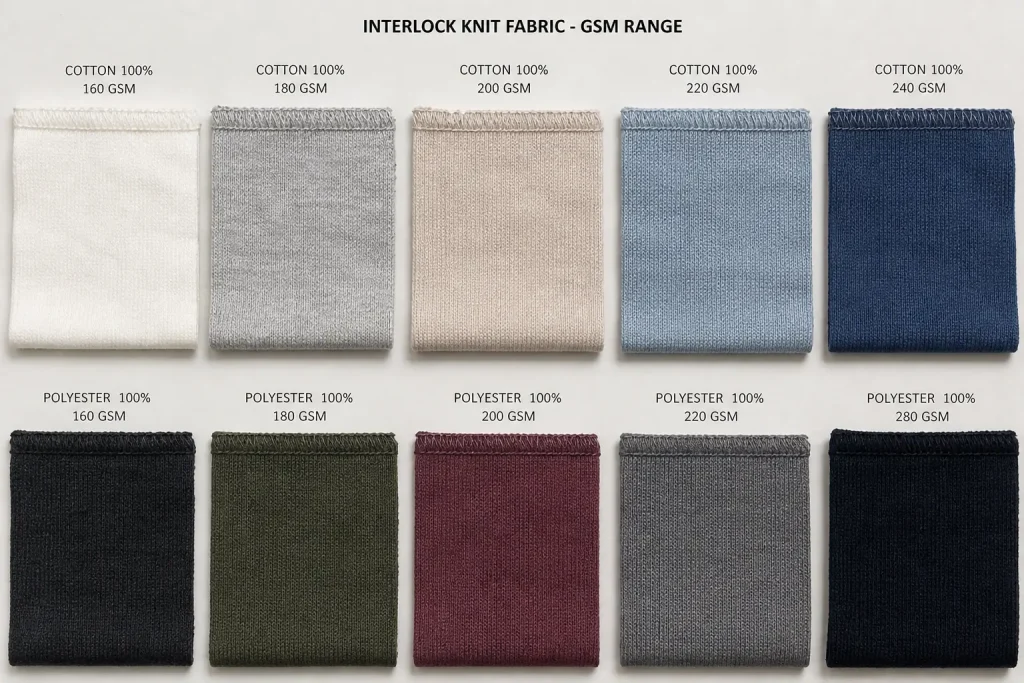
Reference ranges below are based on Runtang Tex's internal production experience across 4,000+ developed fabric styles:
Interlock knit fabric swatches showing different GSM ranges and fiber compositions for fabric selection
If your end use sits between categories — for example, a fitted top intended for both casual and light performance use — the sampling stage is the right moment to test two GSM options side by side rather than committing to one specification upfront.
How to Verify Certification Scope Before Sampling
Two certifications are most commonly requested for interlock fabric sourcing from China: OEKO-TEX® Standard 100 and Global Recycled Standard (GRS). The critical point most buyers miss is that certification coverage is not blanket across all fabrics a factory produces. A factory may hold certification for specific constructions — typically its higher-volume standard styles — but not for every custom blend or GSM variant.
Confirm certification scope at the sampling stage, not after bulk order placement. The table below maps each certification to its verification process:
Certification
Typical Sourcing Scenario
How to Verify Scope at Sampling Stage
OEKO-TEX® Standard 100
Kidswear, underwear, next-to-skin garments where chemical safety is a brand or retail requirement
Verify the certificate number at the OEKO-TEX® Label Check platform. Also confirm that the product scope and product class listed on the certificate cover the specific interlock fabric construction you are ordering — not only that the certificate number is valid.
Global Recycled Standard (GRS)
Activewear or casualwear collections with recycled fibre claims, particularly for European market sustainability requirements
Verify the supplier's Scope Certificate through Textile Exchange's certified company database. Confirm whether Transaction Certificate documentation can be provided for the specific shipment. GRS verifies recycled material content and chain of custody, with additional social, environmental, and chemical processing requirements — it does not test finished fabric performance properties.
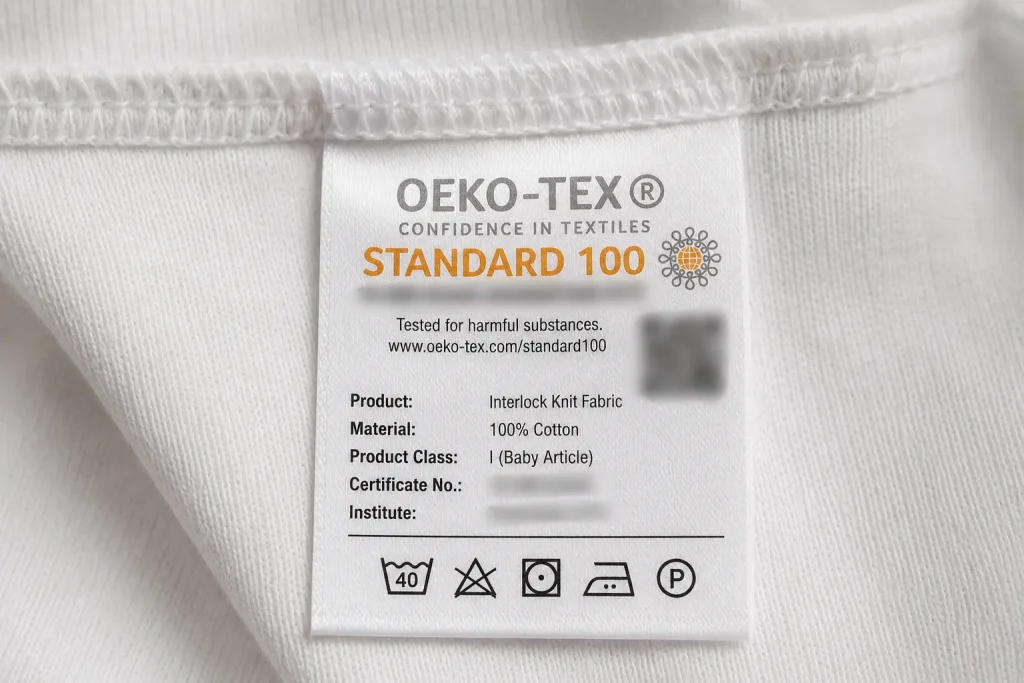
OEKO-TEX certified interlock knit fabric label detail showing certificate number and product class for apparel sourcing verification
If a supplier cannot provide a certificate number, the registered facility name, or the product scope on request, treat this as a flag that needs resolution before sampling rather than after. Details on our certifications — including covered fabric constructions — are available on our About page. For independent verification, OEKO-TEX® certificate numbers can be checked at the OEKO-TEX® Label Check platform.
MOQ, Lead Times, and What a Realistic Timeline Looks Like
One of the most common friction points in first-time sourcing from a Chinese knit fabric factory is misaligned timeline expectations — particularly when buyers assume sampling is faster than it is, or that bulk can start immediately after lab dip approval.
Below are typical milestones for a custom solid-colour interlock order:
Stage
Typical Timeframe
Lab dip (colour matching)
3–7 days
PP sample (pre-production)
15 days from lab dip approval
Bulk production
25–45 days from PP sample approval
MOQ (custom solid colour)
300 kg per colour
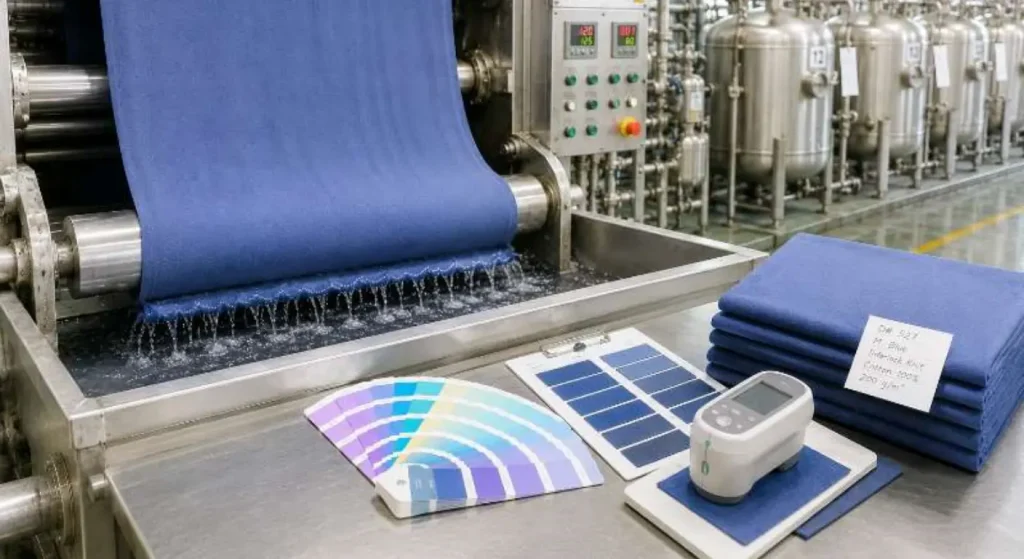
Interlock knit fabric in production at Runtang Tex dyeing facility, showing in-house colour matching process for bulk orders
A few practical notes on these timelines:
Lab dip turnaround varies by fibre. Cotton and cotton/spandex interlocks typically match within 3–5 days. Blends involving modal, viscose, acrylic, or multi-component yarns may require an additional round depending on dye uptake.
Bulk lead time (25–45 days) assumes PP sample approval without major revisions. If the PP sample requires a second round for GSM or hand-feel adjustment, add 10–15 days to the bulk timeline.
The 300 kg per colour MOQ applies to custom solid-colour production. Stock fabric options carry a lower threshold.
Lead times above are typical reference ranges and should be reconfirmed after lab dip or PP sample approval. Runtang Tex has supplied interlock knit fabric to 300+ apparel brand clients across Europe, North America, and Australia, with 20 million yards of annual production capacity.
FAQ
Should I choose a factory or a trading company for interlock fabric sourcing?
It depends on what you need to control. If GSM consistency, shade matching, and certification traceability are critical to your production — as they typically are for activewear, kidswear, or sustainability-labelled collections — a direct factory gives you cleaner lines of accountability. Trading companies can be a viable route for standard constructions where the producing mill is transparent and documented. In either case, ask for the producing facility's name, machine specifications, and certification registration address before sampling.
What information should I send before requesting an interlock fabric sample?
The more specific your brief, the faster the sample round. At minimum, provide: target GSM (or a range), fibre composition, fabric width, intended garment application, and any certification requirements (e.g., OEKO-TEX® Standard 100 or Global Recycled Standard). If you have a reference fabric, include it. If you have Pantone references for colour, provide those upfront. A well-defined brief reduces lab dip rounds and avoids PP sample revisions.
What is the MOQ for custom interlock fabric from China?
For custom solid-colour interlock at Runtang Tex, the minimum order quantity is 300 kg per colour. Stock fabric options carry a lower threshold. MOQ requirements vary by factory — confirm early, as it affects whether a development programme is viable at your current order volume.
How do I verify certifications when sourcing interlock fabric from a Chinese mill?
Ask for the certificate number, not just a logo. OEKO-TEX® Standard 100 certificates can be verified at the OEKO-TEX® Label Check platform using the certificate number — and also confirm that the product scope and product class listed cover the specific interlock fabric construction you are ordering. For GRS, verify the supplier's Scope Certificate through Textile Exchange's certified company database. If needed, contact the issuing certification body for final verification.
How long does sampling take for custom interlock fabric in China?
Lab dip typically takes 3–7 days. Pre-production samples follow within 15 days of lab dip approval. The total sampling process from first colour submission to PP sample approval generally runs 3–5 weeks, depending on revision rounds. Budget accordingly when planning collection development timelines.
Runtang Tex manufactures interlock knit fabric across 110–420 GSM, with custom solid-colour production from 300 kg per colour and certification options available by fabric construction. Share your target GSM, fibre composition, width, colour, and certification requirements to start sample evaluation.

 Sourcing Guide

