BlogOEKO-TEX Certified Interlock Fabric: A Sourcing Guide for Apparel Brands
OEKO-TEX Certified Interlock Fabric: A Sourcing Guide for Apparel Brands
May 07, 2026
Table of Contents
OEKO-TEX® Standard 100 certification is increasingly a baseline requirement for European and North American apparel brands — particularly for babywear, underwear, and next-to-skin garments. This guide covers which interlock applications make certification most relevant, which fiber and GSM combinations are available with OEKO-TEX® Standard 100, and what to confirm with your fabric source before sampling begins.
When OEKO-TEX® Standard 100 Certification Matters Most for Interlock
Interlock knit is a double-faced, smooth-surfaced fabric most commonly used in garments that sit directly against skin: underwear, base layers, babywear, and fitted T-shirts. These are precisely the categories where OEKO-TEX® Standard 100 carries the most practical weight.
OEKO-TEX® Standard 100 is an independent testing and certification system covering every component of a finished textile — yarn, dye, finishing chemicals, and accessories — for the presence of over 100 harmful substances including restricted azo dyes, heavy metals, pesticides, formaldehyde, and pH deviation. It does not certify farming or labor practices; it certifies chemical safety of the finished fabric.
Three garment categories where interlock brands most commonly require this certification:
Babywear and infant apparel. European and North American retailers often require OEKO-TEX® Standard 100 Class I (the strictest tier, covering products for children under 36 months) for any fabric in this category. Cotton and cotton-blend interlock in 160–220 GSM is the standard substrate.
Underwear and base layers. Adult skin-contact garments typically fall under Class II. Brands distributing through major European retailers or operating under their own sustainability commitments treat OEKO-TEX® Standard 100 as a minimum supplier requirement, not an optional add-on.
Premium basics and fitted T-shirts. As consumer awareness of textile chemicals grows, mid-to-high-end casualwear brands — particularly those targeting the European market — are applying OEKO-TEX® Standard 100 requirements upstream to their fabric suppliers.
For brands distributing through established retail channels in Germany, the Netherlands, Scandinavia, or the UK, certification documentation is increasingly part of the supplier qualification checklist, not an afterthought.
Fiber Options Available with OEKO-TEX® Standard 100 Certification
A common misconception: OEKO-TEX® Standard 100 does not require the fiber to be organic. Conventional cotton, polyester, modal, viscose, and blended compositions can all be certified — what matters is whether the dyes, finishes, and processing chemicals used on that fiber meet the standard's limits.
For interlock specifically, the following fiber directions are available with OEKO-TEX® Standard 100 coverage at our Foshan production facility. Certification must be confirmed at the enquiry stage, as it applies per production batch, not per fabric style universally.
Cotton and cotton-blend interlock
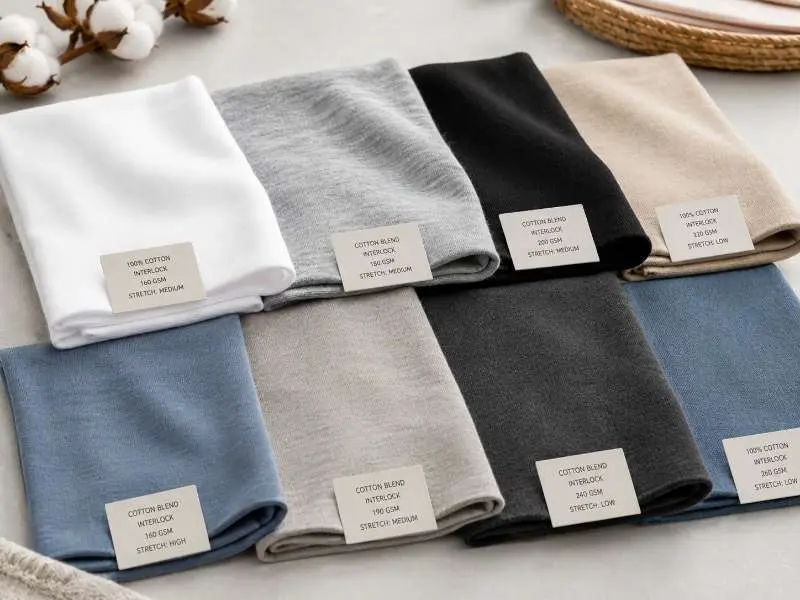
100% cotton interlock, 160–280 GSM — the primary choice for babywear, underwear, and T-shirts where breathability and natural-fiber positioning matter.
Cotton/spandex blends (typically 90–95% cotton, 5–10% spandex), 180–240 GSM — adds stretch recovery for fitted silhouettes while retaining natural-fiber content.
Cotton/viscose blends, 200–280 GSM — common for premium basics where drape and surface smoothness are priorities alongside skin safety.
Polyester and polyester-blend interlock
Polyester/spandex interlock, 170–250 GSM — used for activewear tops and sports bras. OEKO-TEX® Standard 100 coverage on polyester interlock is achievable; confirm dye process at enquiry.
Cotton/polyester blends — balance of natural comfort and synthetic durability, suitable for polo shirts and casualwear. Certification applies per batch and dye lot.
Modal and specialty-fiber interlock
Modal-based interlock (modal/viscose/spandex combinations), 200–260 GSM — used for elevated basics and loungewear. OEKO-TEX® Standard 100 certification is available; confirm at sampling stage.
If a brand requires organic fiber in addition to chemical safety testing, OEKO-TEX® Standard 100 alone is not sufficient. Organic fiber sourcing requires separate certification — Global Organic Textile Standard (GOTS) or ORGANIC 100 Content Standard — and should be specified separately at the enquiry stage. The two certification types address different aspects of the supply chain and are not interchangeable.
Cotton, cotton-spandex, and cotton-viscose interlock options can be selected based on breathability, stretch recovery, drape, and garment positioning.
OEKO-TEX® Standard 100 vs Global Recycled Standard (GRS): Which Applies to Your Brief
Brands with sustainability requirements often face both certifications in the same sourcing brief. The table below clarifies what each covers and when to specify which.
OEKO-TEX® Standard 100
Global Recycled Standard (GRS)
Verification scope
Harmful-substance testing — dyes, heavy metals, pesticides, formaldehyde, pH
Recycled-fibre content — percentage of verified recycled material in the fabric
Primary buyer need
Next-to-skin safety compliance; EU and North American market access
Sustainable raw-material sourcing; brand ESG reporting and disclosure
Applicable garment types
Babywear (Class I), underwear, base layers, any skin-contact interlock
Collections using recycled polyester, recycled cotton, or other recycled-fibre blends
Can both apply?
Yes — a single interlock fabric can carry both certifications simultaneously
Yes — OEKO-TEX Standard 100 and GRS are independent and non-conflicting
When to confirm
Before sampling — specify at enquiry stage so the correct dye process is used
Before sampling — request Transaction Certificates to verify recycled-content chain
Both certifications are available for interlock production at Runtang Tex, and a single fabric order can carry both simultaneously. The requirement to specify upfront applies to both: certification is confirmed per production batch, and the correct dye chemistry and raw-material sourcing must be in place before production begins. Requesting certification after bulk production is not feasible.
For further detail on how OEKO-TEX® Standard 100 testing criteria are defined and updated, refer to the OEKO-TEX® official standard documentation at oeko-tex.com/en/our-standards/oeko-tex-standard-100 (external link, no commercial affiliation).
What to Confirm Before Sampling
Certification status applies at the batch level, not the style level. A factory holding OEKO-TEX® Standard 100 certification does not automatically mean every fabric style it produces — or every dye colour in a given order — has been tested and approved under that certification. Here is what to address before sampling begins.
At the enquiry stage
State the end-use category: babywear (Class I), adult next-to-skin (Class II), or general apparel (Class III). This determines which tier of the standard applies and affects dye selection.
Confirm fiber and GSM target. The certification process covers the specific composition and finish of the fabric ordered — changes to fiber blend or weight after sampling may require re-confirmation.
State whether certification documentation is required to accompany bulk delivery. Test reports and Transaction Certificates serve different purposes in a compliance chain; confirm which format your QC process requires.
At the lab dip stage (typically 3–7 days)
Lab dip approval is the point to confirm dye process compatibility with OEKO-TEX® Standard 100. Colour changes requested after bulk production has begun cannot be retroactively certified.
If GRS certification is also required, confirm recycled-content Transaction Certificates are available for the specific yarn lot being used in production.
At the PP sample stage (typically 15 days)
PP sample approval should be accompanied by confirmation that the production batch will proceed under the same certified dye and finishing process. Any process change at this stage requires re-confirmation with the certification body.
MOQ for custom solid-colour interlock is 300 kg per colour. At 200 GSM, 300 kg corresponds to approximately 1,500 metres — a scale suited to seasonal capsule orders rather than trial runs. For brands exploring certified interlock for the first time, requesting a lab dip and A4-size swatch sample before committing to a bulk order allows specification confirmation without the full MOQ commitment.
FAQ
Does OEKO-TEX® Standard 100 mean the interlock fabric is made from organic cotton?
No. OEKO-TEX® Standard 100 certifies that the finished fabric — regardless of fiber origin — has been tested and found free from specified harmful substances in the dyes, finishes, and processing chemicals used. Conventional cotton, polyester, and blended interlock can all carry this certification. If organic fiber sourcing is a requirement, Global Organic Textile Standard (GOTS) or ORGANIC 100 Content Standard must be specified separately.
Can I request both OEKO-TEX® Standard 100 and GRS certification for the same interlock order?
Yes. The two certifications address different aspects of the supply chain — chemical safety and recycled-fibre content respectively — and are not mutually exclusive. Both must be specified at the enquiry stage. A production batch using GRS-certified recycled polyester can simultaneously be processed under OEKO-TEX® Standard 100 compliant dye chemistry, provided the facility holds both certifications and the order is confirmed accordingly.
Start Your Sourcing Process
Runtang Tex manufactures interlock knit fabric with OEKO-TEX® Standard 100 and GRS certification options for apparel brands across Europe, North America, and Australia. A4-size fabric samples are available before bulk commitment. Specify your end-use category, fiber preference, and certification requirements when requesting a sample or quote.

 Sourcing Guide

